🌍 Records from the halls of power
8 Time Zone Quirks That Warp Daily Life
- What: The article highlights how time zones around the world often depart from neat one-hour boundaries because of political choices, geography, and daylight-saving rules.
- Where: Worldwide, across multiple countries and islands.
- When: Primarily the modern era, with some quirks shaped by historical policy decisions.
Time zones look neat on a map until real life gets involved. Then the clock starts bending around borders, islands, politics, and daylight.
These eight world time-zone quirks show how official local time can drift away from the tidy one-hour pattern people expect, changing commutes, business hours, and even which day it is.
1. Nepal’s 45-minute offset
Nepal uses UTC+5:45, a rare 45-minute time offset. That puts the country on a clock that does not line up neatly with the nearest hour and leaves it sitting between the standard times of its giant neighbors.
It is surprising because most people expect time zones to move in full hours, or at most half-hours. In Nepal, even a simple cross-border time check needs an extra twist.
2. India’s single time zone across a vast country
India keeps one official time zone, UTC+5:30, across a very wide country. The same national clock stretches across longitudes where the sun does not behave the same way at all.
That is why sunrise in India’s east can feel dramatically earlier than in the west. One clock governs both, even when daylight patterns feel very different on the ground.
3. Australia’s half-hour states (South Australia)
South Australia uses UTC+9:30, not a whole-hour offset. In practice, that means a relatively short drive between neighboring parts of Australia can shift the clock by 30 minutes instead of a full hour.
It feels small, but half an hour is enough to disrupt appointments, transport timing, and the simple assumption that nearby places share roughly the same clock.
4. Lord Howe Island 30-minute daylight adjustment
Lord Howe Island does something even stranger: its seasonal clock change is 30 minutes. Rather than shifting by a full hour, the island adjusts by half that amount.
That makes it stand out even among places already known for unusual timekeeping. The result is a local schedule shaped around daylight while still tracking mainland trade and tourism rhythms.
5. Iran’s half-hour offset and daylight peculiarities
Iran uses a half-hour offset, UTC+3:30, and has also had daylight rules that at times differed from those of nearby countries. That combination makes the country’s timekeeping less intuitive than a standard whole-hour zone.
The surprise is not just the offset itself. It is the way cross-border planning can become fiddly when neighboring places do not shift their clocks in the same way.
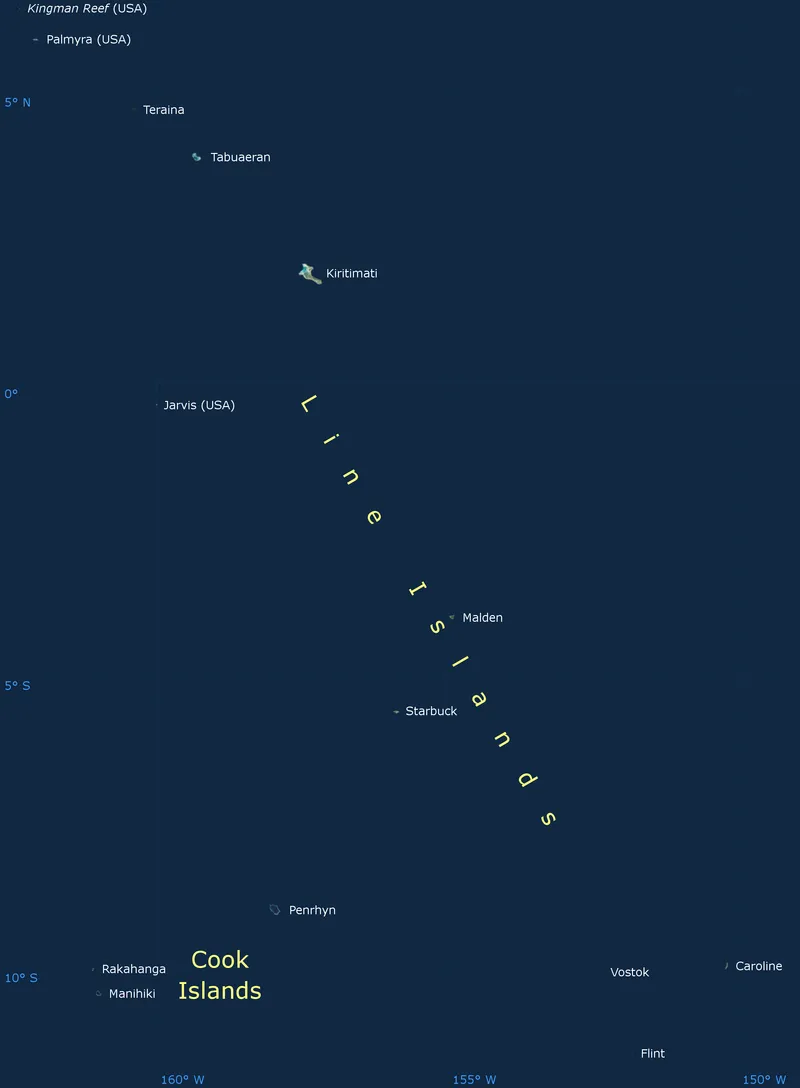
6. Kiribati’s Line Islands jump the date line
Kiribati made one of the boldest time decisions on Earth. To keep the whole nation on the same business day, the international date line was effectively moved for its eastern islands, including the Line Islands.
That created UTC+14, often described as the world’s earliest time zone. In plain terms, one part of Kiribati can be living tomorrow before many other places have finished today.
7. Spain’s ‘wrong’ zone from historic politics
Spain runs on Central European Time rather than the solar time many people would expect from its geography. The mismatch is widely linked to a political decision in the mid-20th century.
That helps explain Spain’s famously late rhythm of daylight and daily life. The official clock sits an hour ahead of what many people imagine the sun should be doing.
8. Newfoundland’s odd half-hour (Canada)
Newfoundland uses UTC-3:30, giving it a 30-minute difference from most nearby mainland time zones in Canada. It is a small offset, but one that never quite lets you relax.
Flights, broadcasts, and schedules all need that extra mental correction. It is one of those tiny clock differences that keeps showing up at exactly the wrong moment.
Together, these places show that time zones are not just geography. They are human decisions, and once they settle into daily life, the clock can start feeling a lot stranger than the map suggests.
Did You Know?
Coordinated Universal Time (UTC) is based on atomic clocks, while leap seconds are occasionally added to keep it aligned with Earth’s slightly irregular rotation.