
🌍 Records from the halls of power
Danakil Desert Salt Caravans Still Cross Ethiopia's Afar Depression
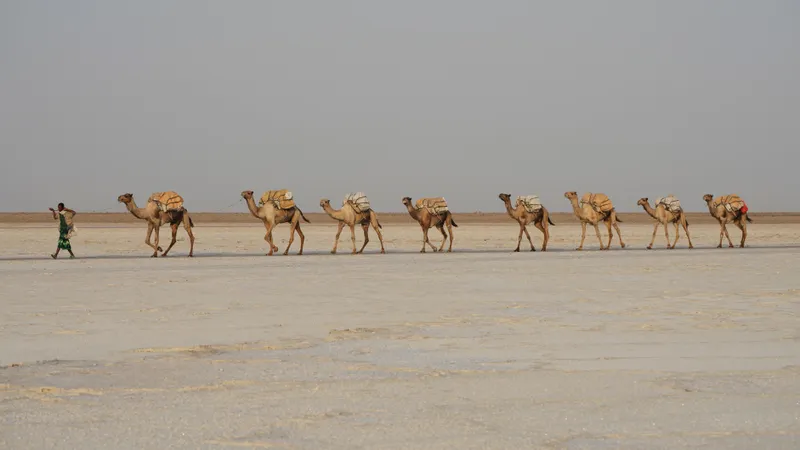
- What: Salt caravans in Ethiopia’s Danakil Desert still transport hand-cut salt by camel, even as trucks now handle much of the trade.
- Where: Danakil Desert in the Afar Depression, northeastern Ethiopia, near Lake Asale and along routes connected to Djibouti.
- When: Contemporary.
By sunrise in northeastern Ethiopia, the Danakil Desert is already glaring white. Across the salt flats of the Afar Depression, lines of camels move in single file, loaded with rectangular slabs cut from the ground itself. This is not a reenactment for visitors. Salt caravans still travel here as part of a working trade system shaped by heat, distance, and routine.
Salt Mining and Caravan Routes
Routes begin around Lake Assal in Djibouti and, more famously in Ethiopia, near Lake Asale, where miners carve salt from the crust by hand. If conditions hold long enough for extraction and loading, the caravan forms. Then the animals are packed, handlers set the pace, and the group starts across one of the hottest regions on Earth. Temperatures in the Danakil have long been known for extreme heat, and travel is timed around what people, animals, and terrain can tolerate.
That is what makes the scene striking. The salt looks almost industrial, flat and geometric, but the movement around it depends on practical knowledge built over generations. Communities in the Afar region have maintained these routes because they connect remote extraction sites to market networks farther inland. Camels remain useful here not because the system is frozen in the past, but because they can carry heavy loads across ground where mechanized transport is not always simple, cheap, or reliable.
How Camel Transport Still Works
The trade has changed. Trucks now handle much of the salt transport in Ethiopia, and road access has altered how goods move. But the caravans have not entirely disappeared. In some areas, camel transport still operates alongside newer logistics, especially where terrain, cost, or local practice keep it viable. That matters because it shifts the story away from nostalgia. The caravan is not just an image from an old travel book. In parts of the Danakil, it is still labor, scheduling, risk, and income.
There is a wider context here too. The Afar Depression is often described through geology and extremes: tectonic activity, low elevation, severe heat. All of that is real. But the human system moving through it is just as important. The caravan routes show how trade networks adapt to harsh environments without becoming museum pieces.
Afar Depression Salt Trade
On the salt flats, that reality stays concrete. Blocks are cut, stacked, tied onto camels, and moved out across the white ground toward market towns. In the Danakil, the caravan still exists because the salt still has to leave the desert.
Did You Know?
The Danakil Depression is one of the lowest-lying places on Earth.