🌍 Records from the halls of power
Mirny Diamond Mine and the Fog It Pulls In
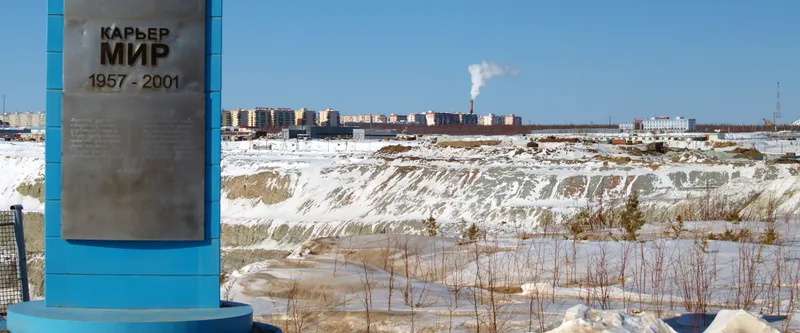
- What: The Mirny diamond mine in Siberia is a huge open-pit mine whose size can cause fog and cold air to collect visibly inside the crater under the right conditions.
- Where: Near the town of Mirny in Russia’s Sakha Republic, eastern Siberia.
- When: Discovered in 1955, with large-scale mining beginning soon after.
In eastern Siberia, the Mirny diamond mine is famous for one thing first: its size. Near the town of Mirny in Russia’s Sakha Republic, the open pit grew into one of the largest excavated holes on Earth, measuring roughly 1.2 kilometers across and more than 500 meters deep at its peak open-pit stage.
That scale gave the mine a second reputation. On calm days, observers have described fog and cold air sinking into the crater, creating a striking local weather effect above the pit. It is not a supernatural pull or a giant vacuum. It is a result of the mine’s shape, depth, and temperature differences between the air above and the air inside the hole.
Mirny Mine History and Scale
Mir was discovered in 1955 during the Soviet diamond rush, and large-scale mining began soon after. For decades, trucks spiraled down the pit walls to reach kimberlite, the volcanic rock that can carry diamonds from deep in the mantle toward the surface. The open-pit operation eventually became so large that its benches and roads looked miniature from above, even though each level was built for heavy industrial machines.
How the Crater Pulls In Fog
The weather effect is easier to understand than the photographs make it seem. Deep pits can trap colder, denser air, especially when winds are weak. If moist air passes over the opening, fog can drift downward and collect inside. The crater is not generating weather from nothing; it is reshaping the air already there. In a place like Siberia, where temperature contrasts are often strong, that effect can be unusually visible.
Mirny is also often described as visible from space. That broad idea is plausible in the sense that large mines can be identified in satellite imagery, but casual claims should be stated carefully: visibility depends on the sensor, altitude, resolution, light, and what “visible” actually means. What is beyond dispute is that the mine is enormous on the ground and obvious in aerial and satellite views.
Why Mirny Stands Out
The scale is the real point. A human excavation large enough to alter local airflow, hold its own pool of cold air, and swallow drifting fog is not just a hole in the earth. It is a landscape-sized industrial feature.
Today, Mirny remains one of the best-known diamond mining sites in the world. The hard fact is simple: this Siberian mine became so deep and so wide that, under the right still conditions, the crater itself can visibly channel fog down into it.
Did You Know?
The mine is now closed to open-pit mining and is mainly known today as a landmark of Soviet-era diamond extraction.