
🎭 Fragments from the heart of civilization
Vermeer Paintings Show Tiny Pinholes at Their Perspective Points
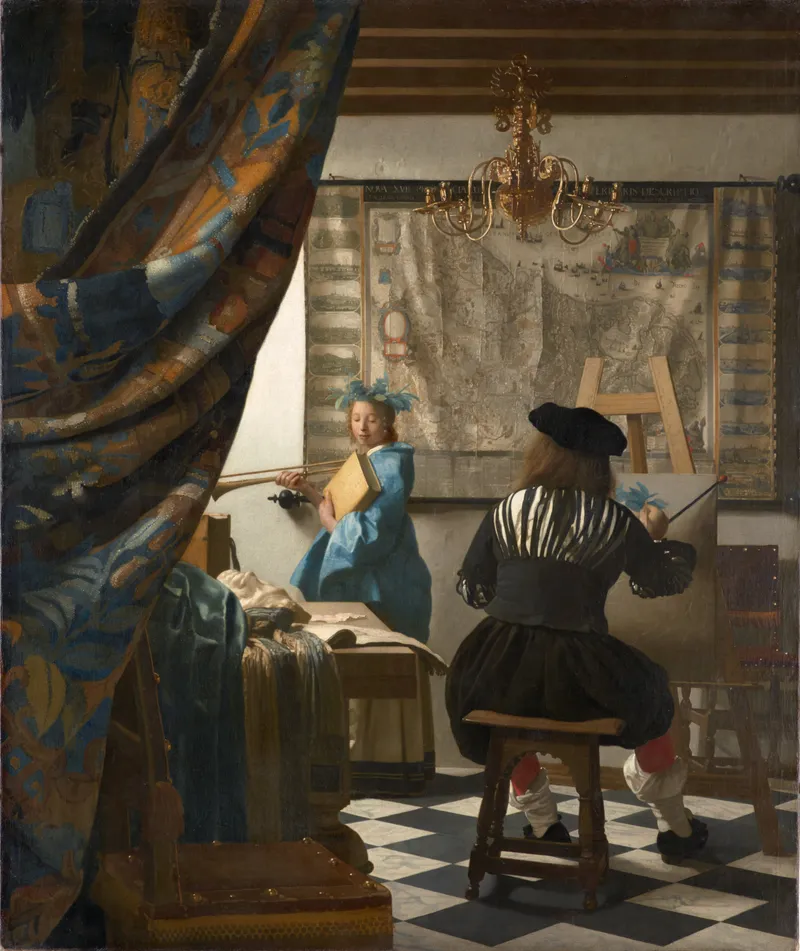
- What: Some paintings by Johannes Vermeer contain tiny pinholes at their vanishing points, which conservators interpret as evidence that he may have used a string-and-pin method to construct perspective.
- Where: In Vermeer’s interior scenes, likely painted in Delft.
- When: 17th century.
Some Johannes Vermeer paintings contain tiny pinholes at their vanishing points. Conservators and art historians have taken those marks as physical evidence that the 17th-century Dutch painter may have used a very simple aid for perspective: a pin or nail set into the canvas or panel, with a string attached to map lines receding into space.
Vanishing Point Pinholes
The marks are small, but they matter because they sit in exactly the place where a room’s geometry locks together. In works associated with Vermeer’s interiors in Delft, straight architectural lines, floor tiles, window frames, and furniture edges all seem to converge with extraordinary control. A pinhole at that center point would have given him a fixed anchor. From there, a taut string could be moved and traced to establish accurate sight lines across the composition.
This does not mean every line in every Vermeer was mechanically plotted, and it is not definitive proof of every step in his process. But the pinholes are one of the rare cases where the surface of a painting still preserves a workshop decision in physical form. Instead of relying only on style comparison or speculation, conservators can point to an actual mark left in the support.
Evidence of Vermeer’s Method
The finding also corrects a common misconception about realism in old master painting. People often imagine great painters simply looked harder than everyone else and somehow transferred reality by instinct alone. In practice, artists in Vermeer’s time used tools, measurements, and studio methods. That does not make the result less impressive. If anything, it shows how carefully constructed the illusion was.
Vermeer is often discussed alongside possible optical aids, especially the camera obscura, but those debates remain more complicated. The pinholes are a narrower and more grounded kind of evidence. They suggest not a mysterious hidden technology, but a basic workshop technique available in the 1600s: fix the vanishing point, stretch the string, build the room.
Perspective Tools in Painting
That tiny puncture changes how the paintings read at close range. The calm, luminous interiors that now hang in museums were not only observed; they were engineered. In a Vermeer room, the realism may hinge on a mark no larger than a needle prick, placed exactly where the space snaps into order.
Did You Know?
Vermeer’s best-known paintings include Girl with a Pearl Earring and View of Delft.