
🧩 Fragments from the unknown
Antikythera Mechanism Reveals Ancient Greek Astronomical Engineering
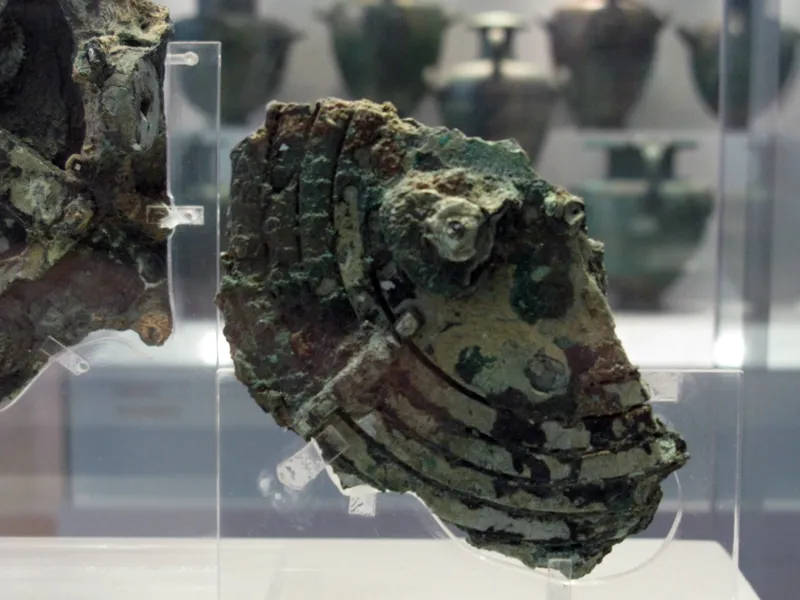
- What: The Antikythera mechanism was an ancient Greek bronze device with at least 30 gears that modeled astronomical cycles, including the motions of the Sun and Moon and eclipse patterns.
- Where: It was recovered from a shipwreck off the Greek island of Antikythera.
- When: The shipwreck is usually dated to the 1st century BCE, and the device had been underwater for roughly two thousand years.
The Antikythera mechanism looked like scrap when it came up from a shipwreck off the Greek island of Antikythera. The wreck, usually dated to the 1st century BCE, had been lying underwater for roughly two thousand years. Among statues, cargo, and corroded metal fragments was a broken bronze device packed with gears.
How the Antikythera Mechanism Worked
That detail changed everything. Researchers eventually found that the mechanism used at least 30 interlocking bronze gears. It was not a simple timekeeper or decorative object. It was a compact machine designed to track cycles in the sky: the movements of the Sun and Moon, the lunar calendar, and even eclipse patterns.
Its surviving fragments are incomplete, which means some details are still reconstructed rather than directly preserved. But the basic picture is clear. By turning a crank, a user could set a date and read different dials that modeled known astronomical cycles. Inscriptions on the device helped explain what the scales meant and how the system worked. This was mechanical calculation in bronze.
Why the Antikythera Mechanism Matters
What makes the Antikythera mechanism so striking is not just that it is old. It is that its complexity appears far earlier than many people expect. Gear trains this sophisticated are unmatched in surviving devices for more than a millennium. The mechanism shows that Hellenistic engineers were capable of precision design, miniaturized components, and abstract mathematical modeling translated into hardware.
That matters in context. Ancient science is often imagined as theory on paper and geometry in the abstract, while advanced machinery is treated as a much later development. The Antikythera mechanism cuts across that assumption. It suggests that at least some ancient Mediterranean workshops could build instruments that combined astronomy, mathematics, and fine metalworking at a very high level.
Antikythera Shipwreck Discovery
The ship that sank near Antikythera carried luxury goods across the sea. It also carried, apparently, a machine that could represent celestial cycles with geared accuracy. Even in broken form, the mechanism leaves a concrete implication: by the 1st century BCE, someone had already built a portable astronomical calculator sophisticated enough to predict eclipses and display cosmic time through bronze wheels.
Did You Know?
The mechanism is often described as the oldest known analog computer.