
🚀 Whispers from the silent cosmos
Enceladus Plume Silica Points to Hydrothermal Activity
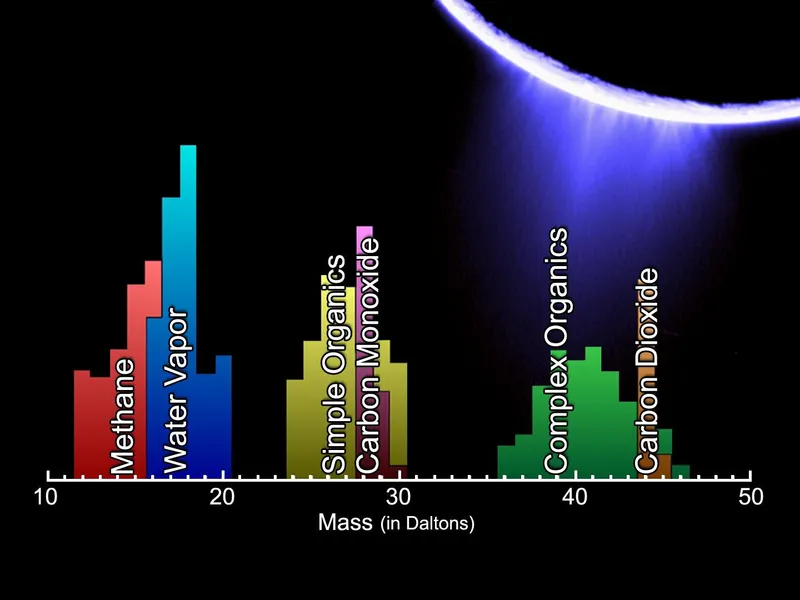
- What: Cassini detected tiny silica nanoparticles in Enceladus’s plume, providing evidence that warm water inside the moon has interacted with rock through hydrothermal activity.
- Where: In the plume and subsurface ocean system of Saturn’s moon Enceladus.
- When: Cassini’s plume flybys in the late 2000s and early 2010s.
Cassini flew through the plume of Saturn’s moon Enceladus and found something unexpectedly small: tiny silica nanoparticles. Those grains mattered because they pointed to a much bigger process happening below the ice.
Cassini Plume Silica Detection
The key finding came from data gathered during Cassini’s years at Saturn, especially plume flybys in the late 2000s and early 2010s. Enceladus is a small icy moon, but it sends water vapor and ice grains blasting from fractures near its south pole. Mixed into that material, scientists detected nanoscale silica particles that are difficult to make in cold surface conditions. Their size and chemistry instead fit a hotter story.
Hydrothermal Activity Beneath Enceladus
A leading explanation is hydrothermal activity under the crust. In that scenario, liquid water deep inside Enceladus circulates through a rocky seafloor and reacts with warm rock. Those water-rock reactions can dissolve minerals and then produce silica nanoparticles as the fluid cools and moves upward. Eventually, some of that material reaches the subsurface ocean and escapes into space through the plume.
That matters because the plume is not just spray from an icy shell. It samples the moon’s interior. Scientists do not need to drill through miles of ice to get clues about what is happening below. Enceladus is effectively throwing pieces of its hidden ocean system into space, where a spacecraft can measure them directly.
Evidence for an Active Ocean
The silica finding did not stand alone, either. Cassini also detected salts, organic compounds, and signs consistent with a global ocean beneath the ice. But the silica particles were especially important because they tied the ocean to active contact with rock and heat. This was not just a sealed pocket of cold water. It appeared to be a dynamic environment where chemistry was still happening.
The implication is that when Cassini sampled Enceladus’ plume, it was collecting evidence that hot water had interacted with rock inside the moon. Those tiny silica grains became direct clues to an active interior, making Enceladus one of the clearest places in the solar system where an underground ocean and hydrothermal chemistry seem to meet.
Did You Know?
Cassini launched in 1997 and entered Saturn orbit in 2004.