🧪 Echoes from the lab
Schiaparelli Mars Lander Crash Caused by Sensor Saturation
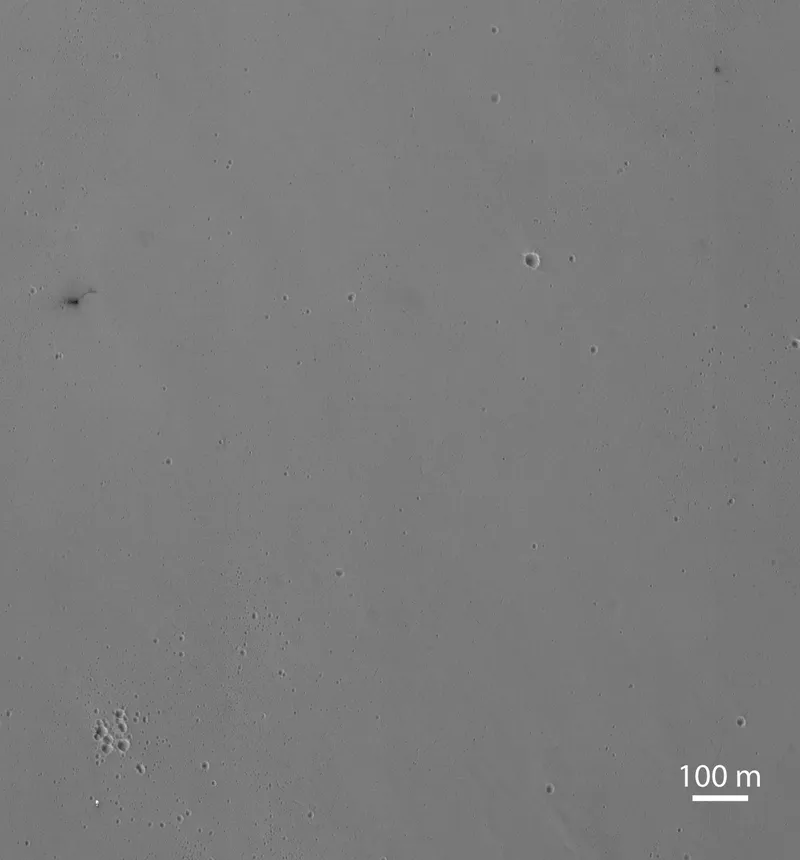
- What: ESA’s Schiaparelli Mars lander crashed after a brief IMU sensor saturation caused its navigation system to compute a false negative altitude and trigger the wrong descent sequence.
- Where: Meridiani Planum, Mars
- When: October 2016
In October 2016, ESA’s Schiaparelli lander was supposed to demonstrate a controlled descent to the surface of Mars. Instead, it crashed in Meridiani Planum after a brief sensor problem fed bad data into its navigation sequence.
IMU Saturation During Descent
The failure happened during the most delicate phase of the mission: entry, descent, and landing. Schiaparelli entered the Martian atmosphere, deployed its parachute, and began slowing down as planned. Then its inertial measurement unit, or IMU, briefly saturated. In simple terms, the sensor was pushed beyond the range it could accurately measure while the lander was rotating under the parachute.
That brief saturation mattered because the lander’s guidance, navigation, and control software was combining IMU readings with other data to estimate altitude and motion. The faulty state estimate led the onboard system to calculate a negative altitude, effectively treating Schiaparelli as if it were already at or below the surface when it was still several kilometers up.
Negative Altitude Triggered Crash
Once that happened, the descent sequence unraveled quickly. Schiaparelli prematurely released its parachute and backshell. Its liquid-fueled thrusters then fired, but only for a few seconds instead of the much longer burn needed to slow the vehicle for landing. After that, the lander entered free fall and struck the surface at high speed.
The key point is that the crash was not caused by a single broken part in isolation. A brief sensor saturation cascaded through software logic that did not adequately handle the resulting estimate. The problem was not that the IMU briefly exceeded its limits alone; it was that this upset the navigation solution enough to trigger events reserved for the final moments before touchdown.
Lessons From Schiaparelli Failure
ESA’s post-flight analysis made Schiaparelli an unusually clear example of how edge-case dynamics can propagate through an automated landing system. Mars landings already operate with long communication delays, so the vehicle has to respond on its own in real time. That makes state estimation and fault handling as mission-critical as parachutes, engines, and heat shields.
The concrete implication is visible in the sequence itself: one brief burst of unusable motion data led to a negative altitude, and that false altitude directly caused early parachute release and early thruster cutoff. Schiaparelli reached Mars in 2016, but because its landing logic acted on the wrong state at the wrong moment, it never completed the landing demonstration it was built to perform.
Did You Know?
ESA’s investigation found that the lander’s descent module was expected to operate autonomously for only a few minutes during landing, because Mars communication delays prevent real-time control from Earth.