
🏺 Recovered from the dusty archives
Timur and the Skull Towers Used to Spread Fear
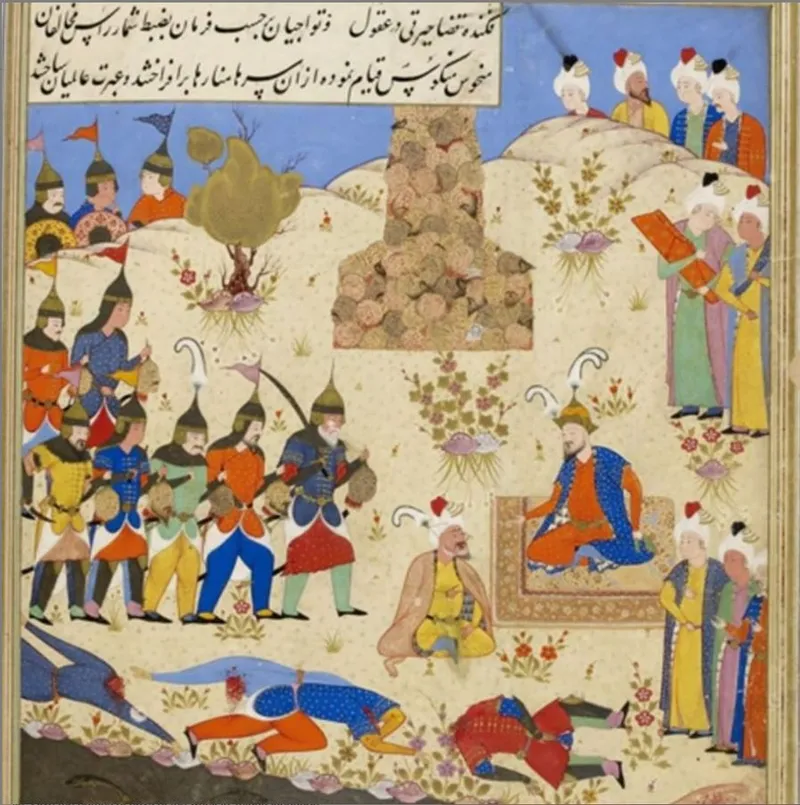
- What: The article explains that reports of Timur using skull towers or pyramids of skulls after conquest were meant to spread fear, though the exact numbers and some details in the chronicles are uncertain.
- Where: Across Timur’s empire and campaigns in Persia, India, Syria, and other parts of Central Asia and the Middle East.
- When: Late 14th and early 15th centuries.
Timur, known in the West as Tamerlane, is often linked to one of the most chilling images in medieval warfare: towers or pyramids of skulls raised after conquest. Reports of this appear again and again across accounts of his campaigns in the late 14th and early 15th centuries, from Persia to India and Syria. But while the image is deeply rooted in the historical record, exact numbers and specific scenes are often hard to verify and were sometimes amplified by chroniclers.
Reports of Skull Towers
The pattern matters more than any single total. When Timur captured cities that resisted him, chroniclers described mass killings followed by the public display of skulls from the dead. After the sack of Isfahan in 1387, some sources claimed enormous numbers of victims and the construction of skull towers. Similar stories appear after campaigns in places such as Delhi in 1398 and Aleppo and Damascus in the early 1400s. These accounts vary in detail, and medieval figures are notoriously unreliable, but the broader theme is consistent: violence was staged to be seen.
This was not random brutality. Timur was building an empire across Central Asia, Iran, Mesopotamia, and beyond, and fear could move faster than an army. In a world where news traveled by merchants, refugees, and rival envoys, visible punishment became a message. Resist, and the consequences would not remain inside city walls. They would be displayed in a form meant to outlive the battle itself.
Timur's Use of Terror
That does not mean every famous story should be taken literally. Medieval chroniclers wrote with agendas. Some wanted to glorify Timur’s power. Others wanted to condemn him. Numbers were often exaggerated, and dramatic details could spread because they fit his reputation. Still, even cautious historians generally agree that Timur used exemplary violence and terror as deliberate tools of rule and war.
The lasting consequence was strategic as much as psychological. A city deciding whether to submit was not judging only Timur’s army in front of its gates. It was judging the memory of what had happened elsewhere. The alleged skull towers mattered because they turned past victims into future warnings.
Skull Towers as Warning
That is why the image endured. Whether each reported pyramid looked exactly as later retellings describe, the core point remains concrete: across Timur’s campaigns from Samarkand to Delhi to Damascus, public displays of the dead were part of how he governed by fear before he ever governed by law.
Did You Know?
Timur’s birthplace is commonly identified as near Kesh, in present-day Uzbekistan.