
🧪 Echoes from the lab
Coral Carbon Isotopes Reveal the Ocean's Suess Effect
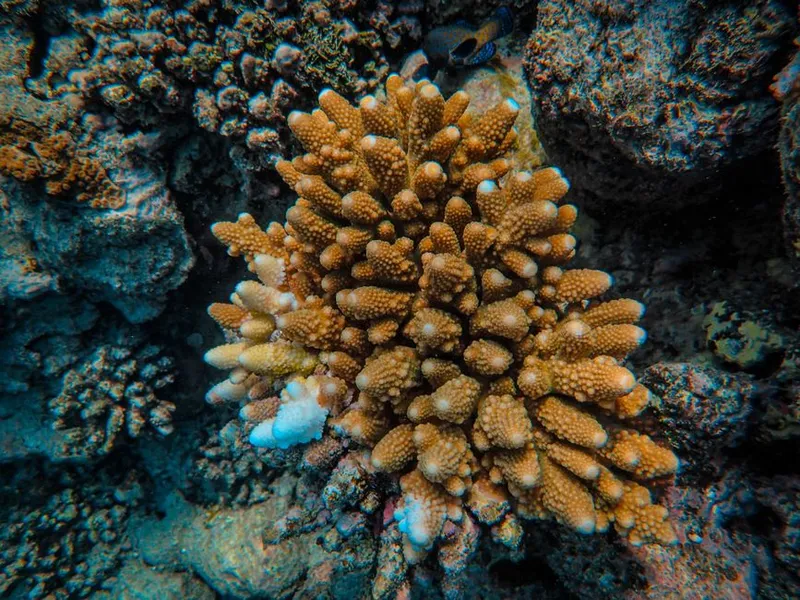
- What: Coral skeletons can preserve the industrial-era decline in carbon-13 from fossil-fuel CO2, giving scientists a year-by-year record of the ocean Suess effect.
- Where: Reef environments, including massive corals such as Porites in the Great Barrier Reef and the tropical Pacific.
- When: The industrial age, especially the last century or more.
Coral skeletons record one of the clearest chemical fingerprints of the industrial age: a drop in carbon-13 relative to carbon-12 caused by fossil-fuel CO2. That shift, known as the Suess effect, shows up not just in the air, but in the ocean, and corals can preserve it year by year.
How the Ocean Suess Effect Works
The basic idea is simple. Fossil fuels are made from ancient organic matter, and that organic matter is relatively depleted in carbon-13. When coal, oil, and gas are burned, the carbon dioxide released carries that lighter isotopic signature. As atmospheric CO2 rises, the ratio of carbon-13 to carbon-12 falls. Some of that added CO2 dissolves into seawater. Reef-building corals then incorporate dissolved carbon into their calcium carbonate skeletons as they grow.
Coral Growth Bands and Carbon Isotopes
Because many corals lay down growth bands a bit like tree rings, scientists can sample a colony along its growth axis and reconstruct changes through time. In massive corals such as Porites, which can live for decades to centuries in places like the Great Barrier Reef and across the tropical Pacific, those bands create a dated archive of ocean chemistry. When researchers measure carbon isotopes in successive layers, they can track the industrial-era decline in carbon-13 with surprising precision.
That makes corals especially useful. A living coral on a reef is not just reacting to temperature or storms in the moment. Its skeleton is also storing a chemical diary of carbon entering surface waters over the last century or more. The signal is measurable enough that scientists can compare coral records from different regions and see both the global influence of fossil-fuel emissions and local differences in ocean circulation, biology, and air-sea exchange.
Why Coral Records Matter
The larger context is what gives this record its value. Direct atmospheric CO2 measurements only go back to the mid-20th century in detail, but industrial emissions began reshaping the carbon cycle earlier. Corals help bridge that gap by preserving a marine response to the same process. They do not replace ice cores, atmospheric monitoring, or ocean sampling, but they connect those records at the ocean surface, where carbon from the air first enters reef environments.
So when scientists drill a coral core and read its isotope layers, they are not extracting an abstract climate signal. They are measuring the industrial-era fall in carbon-13 embedded in reef limestone, a century-scale record of fossil-fuel carbon moving from the atmosphere into the sea.
Did You Know?
Researchers can use coral growth bands, much like tree rings, to date changes in seawater chemistry layer by layer.