🧩 Fragments from the unknown
Jesse Marcel's Roswell Quote and Why It Lasted
It was not a weather balloon
- Who: Major Jesse Marcel, a Roswell Army Air Field intelligence officer.
- Where: In a 1979 interview reflecting on debris recovered near Roswell, New Mexico.
- When: 1979, years after the 1947 Roswell incident.
- Why: It mattered because Marcel’s firsthand recollection challenged the official weather-balloon explanation and helped keep the Roswell mystery alive in public memory.
“It was not a weather balloon” is a widely cited line connected to Roswell, but it was not spoken in 1947. Major Jesse Marcel said it decades later, including in a 1979 interview, while looking back on the debris he had handled after a rancher found unusual material near Roswell, New Mexico.
Roswell 1947 Official Reversal
That timing matters. In July 1947, the Roswell Army Air Field first announced that it had recovered a “flying disc,” then quickly reversed course and said the wreckage was from a weather balloon. Marcel, an intelligence officer at the base, was part of the recovery and became linked to the episode from the start. For decades, though, the public version of the story was the official one: balloon, misunderstanding, end of matter.
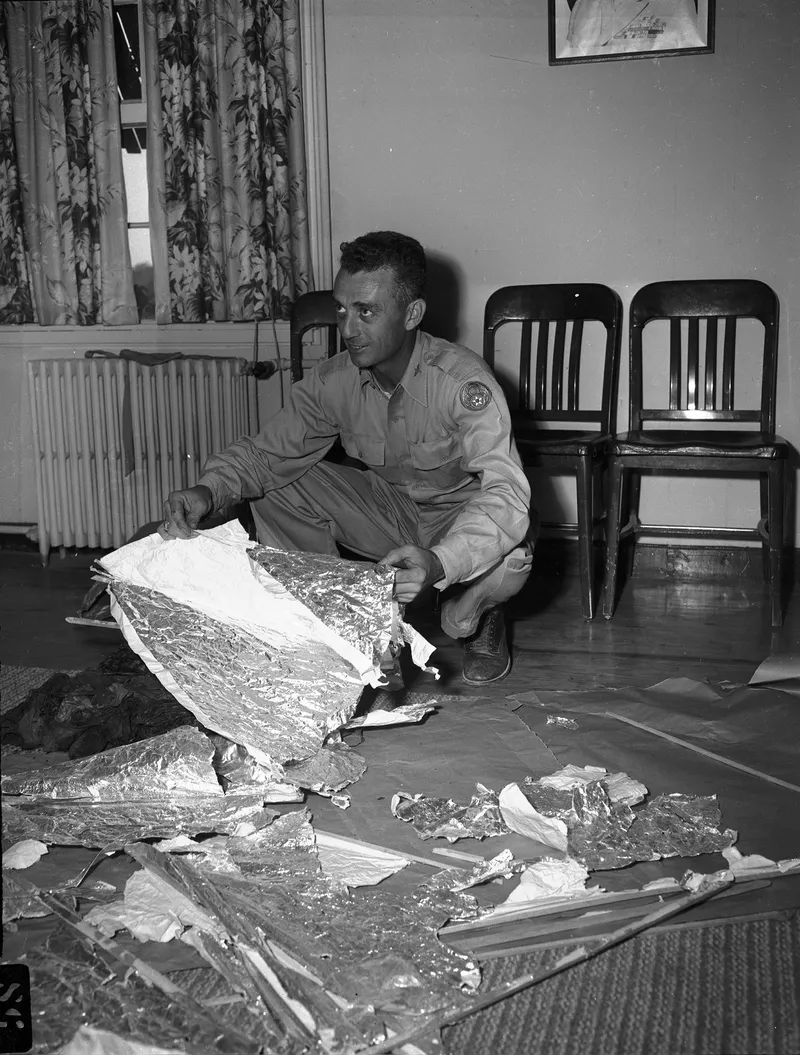
His 1979 recollection reopened it. Marcel was not offering a slogan or a polished line. He was making a firsthand claim, years after the event, that the material did not match the explanation given at the time. That is why the quote mattered. It did not prove what the debris was, and historians should not treat memory alone as conclusive evidence. But it directly challenged the simplest official account from someone who had been there.
Why Jesse Marcel’s Quote Stuck
The wording helped the line stick. Marcel did not say he had solved the mystery. He said he recognized what it was not. That narrow, concrete phrasing gave the quote force. A trained military officer was describing a mismatch between his experience and the explanation the public received. The phrase “not a weather balloon” sounded practical rather than theatrical, which made it easy for listeners to repeat and hard to dismiss as mere fantasy.
It also resonated because of when it emerged. By the late 1970s, distrust of official statements had grown in the United States, and interest in UFO cases was rising again. Roswell, once a brief 1947 news cycle, was becoming a larger cultural mystery. Marcel’s statement fit that moment exactly: a witness from the original event saying, in plain language, that the familiar explanation did not satisfy him.
Why the Roswell Quote Endures
That is why the quote endures. It sits at the center of the Roswell timeline, but from a later vantage point: not the first military press release, not the later government reports, but a remembered objection from one of the men closest to the debris. The line is still recalled because it does something simple and consequential. It keeps the gap open between the documented 1947 reversal and what Marcel said he believed he saw.
Did You Know?
The quote is often cited as part of the Roswell story, but Marcel said it decades after the 1947 incident, not at the time.