🌿 Stories carved by wind and water
Pangolin Tongue Anatomy Is Stranger Than Most People Realize
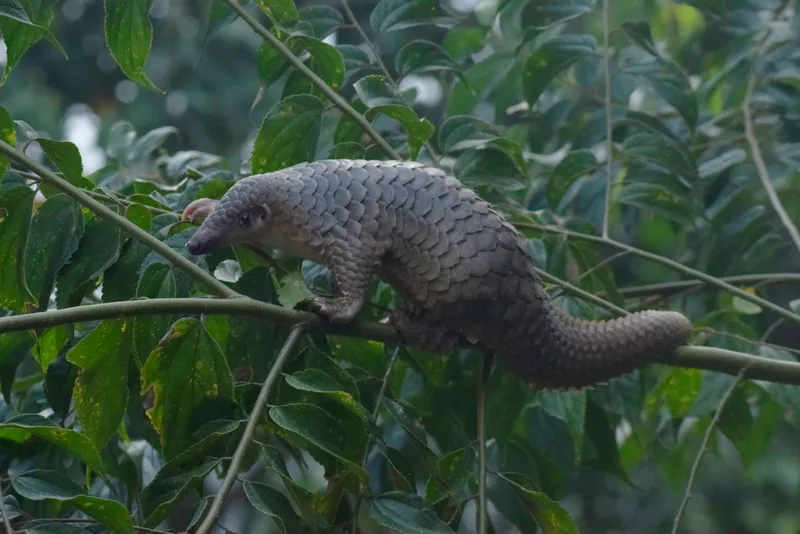
- What: Pangolins have unusually long, deeply supported tongues that help them eat ants and termites without teeth.
- Where: Africa and Asia.
- When:
A pangolin’s tongue does not start where most people assume it does. In these ant-eating mammals found in Africa and Asia, the tongue is rooted deep in the body, extending down through the chest, with attachment structures reaching back toward the sternum and, in some species, farther toward the rear of the torso.
That unusual layout solves a very specific problem. Pangolins feed mainly on ants and termites, and they do it without teeth. Instead of chewing, they rely on an extremely long, sticky tongue that can probe deep into nests and narrow tunnels. To make that tongue long enough, evolution did not simply stretch the mouth. It reorganized the animal’s internal anatomy.
Pangolin Tongue Anatomy
The pangolin’s tongue is supported by elongated muscles and the hyoid apparatus, a set of bones and tissues associated with the tongue and throat. In pangolins, those structures extend far beyond the usual position seen in most mammals. The tongue can retract into a sheath that runs through the chest region, which is why the animal can project it well beyond the length of its head.
This is the part many people get wrong: the tongue is not literally anchored to the pelvis in the simple, everyday sense people imagine, like a rope tied to a hip bone. Descriptions vary by species and source, and the anatomy is more precise than that shorthand suggests. What is true is that the tongue’s supporting structures reach unusually far down the body, much farther than in a typical mammal, and that deep placement is what allows the remarkable extension.
How Pangolins Feed Without Teeth
The rest of the pangolin’s body matches the same feeding system. Its claws tear open insect nests. Its narrow snout gives the tongue access. Sticky saliva helps trap prey. Then the pangolin swallows the insects whole, and digestion takes over where teeth do not.
Naturalists and anatomists have long noted this arrangement because it looks almost improvised compared with more familiar mammals. But it is not a novelty for its own sake. It is a practical redesign for a specialist diet, built around reaching food hidden behind packed soil, wood, and insect defenses.
Why the Tongue Extends So Far
The hard fact is simple: a pangolin’s tongue works because much of its support system sits deep in the chest and extends unusually far along the body, allowing a toothless mammal to feed with a tongue that can reach far beyond its skull.
Did You Know?
Pangolins also have no visible teeth at all, so they swallow their prey whole.