
🛍️ Artifacts of human ingenuity
Xerox PARC, Apple, and How the GUI Went Mainstream
- What: The article explains how Xerox PARC demonstrated an early graphical user interface, while Apple helped turn it into a mainstream personal-computing standard.
- Where: Xerox PARC in Palo Alto, California, and Apple’s personal-computer market.
- When: Primarily the 1970s through the 1980s, especially the 1979 Apple visit, the 1981 Xerox Star, and Apple’s 1983–1984 Lisa and Macintosh releases.
Xerox built the future early. Apple made sure ordinary people actually saw it.
That contrast sits at the center of one of computing’s most repeated stories. In 1979, Apple engineers visited Xerox PARC in California and saw demonstrations of the Alto, a research computer built around windows, icons, and a mouse. This was not a secret invention suddenly stolen from nowhere, and it was not yet a mass-market product either. It was a glimpse of a different way to use a computer.
Xerox PARC and the Alto
The Alto had been developed earlier in the 1970s at PARC, Xerox’s Palo Alto Research Center. It was designed for researchers, not store shelves. It showed that graphical computing could work: a screen full of documents, overlapping windows, on-screen pointing instead of typed commands. In practical terms, that was a huge shift from the command-line world most users still faced.
Xerox did try to commercialize the idea. In 1981 it launched the Xerox Star, a workstation that brought PARC concepts into an office product. But the Star was expensive and aimed at businesses, especially large offices. It was not built to become a broadly accessible consumer machine, and Xerox itself was still primarily organized around copiers, printers, and office systems.
Apple Lisa and Macintosh
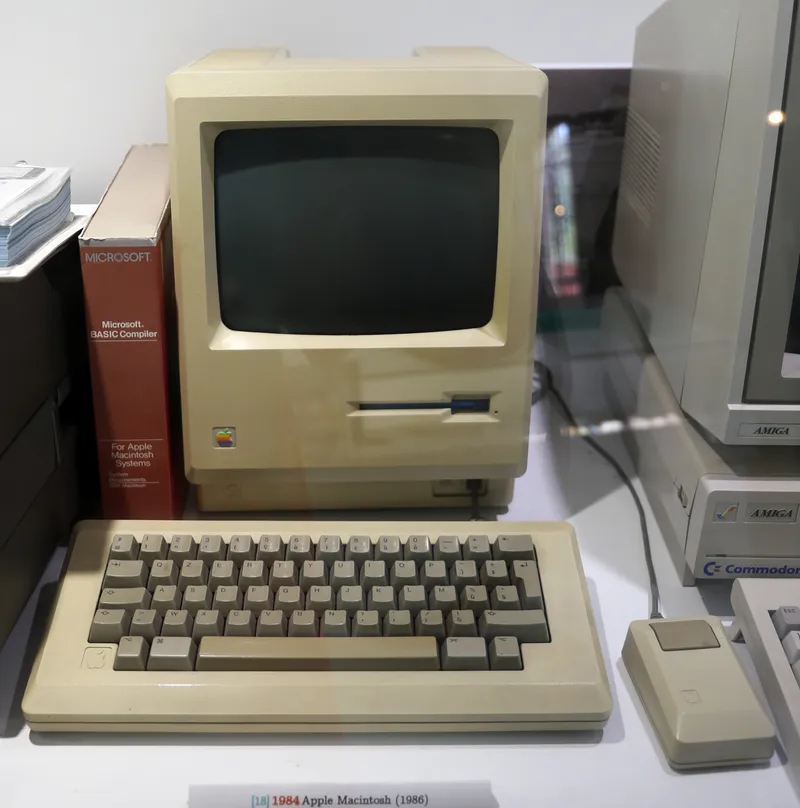
Apple took a different path. The Lisa arrived in 1983, also expensive, but explicitly positioned as a personal computer with a graphical interface. Then came the Macintosh in 1984, smaller, cheaper than Lisa, and marketed with unusual force. Apple did not invent the GUI from scratch. It packaged GUI computing into a product, price range, and public story that reached far beyond research labs and corporate workstations.
How the GUI Went Mainstream
The common misconception is that this story is about a single invention and a single inventor. It is really about stages. PARC proved the concept. Xerox shipped an office version. Apple pushed the interface into a form that consumers recognized, developers targeted, and competitors had to answer.
That is why the Alto matters and why the Macintosh matters differently. One showed what graphical computing could be inside a lab and a limited research community. The other helped make the mouse, icons, and desktop metaphor feel normal in everyday personal computing. The mainstream GUI was not born in one moment; it became mainstream when the ideas escaped the lab and landed on desks people could actually buy for.
Did You Know?
The Xerox Alto is often credited with being among the first modern bitmap displays used with overlapping windows and a mouse-driven interface.