🚀 Whispers from the silent cosmos
Voyager Golden Record Carried Human Languages Into Space
- What: The Voyager Golden Record is a gold-plated phonograph record launched aboard Voyager 1 and Voyager 2 to present sounds, images, and greetings from Earth to any future finder.
- Where: On the Voyager spacecraft, now traveling in interstellar space.
- When: Launched in 1977.
In 1977, NASA launched two small spacecraft, Voyager 1 and Voyager 2, with an unusual extra onboard: a gold-plated copper phonograph record designed to introduce Earth to any finder.
What the Golden Record Included
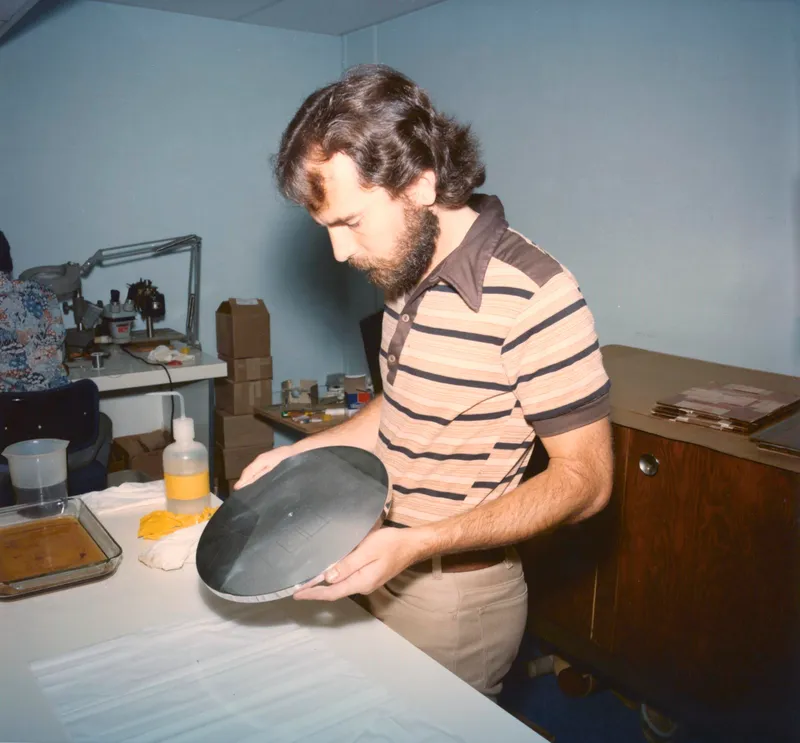
The object itself was deliberate, not symbolic filler. Known as the Voyager Golden Record, it held sounds and images selected by a team led by astronomer Carl Sagan. The package included music, natural sounds from Earth, spoken greetings in 55 languages, and printed instructions for how to play the record. It was less a time capsule than a compact briefing on who humans were, what we sounded like, and how we might be located.
Voyager Golden Record Pulsar Map
One of its most technical features was the pulsar map etched onto the cover. That diagram used the positions of 14 pulsars relative to the Sun, along with the transition of a hydrogen atom, as a reference system. The idea was practical: pulsars emit highly regular signals, so their periods could help indicate both location and the era when the record was made. If an intelligent finder understood the scheme, the map could point back to our Solar System with surprising precision.
The greetings are what most people remember first, but even those were carefully chosen. Voices from dozens of cultures say short messages in languages ranging from Akkadian and Arabic to English, Hindi, Mandarin, and Wu. There is also a greeting from the then-UN Secretary-General Kurt Waldheim and one from U.S. President Jimmy Carter. The record was not meant to represent every language or every society on Earth. That would have been impossible. It was an edited selection built under tight limits of space, time, and technology.
Voyager Record in Interstellar Space
That context matters, because the Golden Record shows how seriously scientists in the 1970s approached the problem of communicating across unimaginable distance. This was not a random mixtape sent into the dark. It was an attempt to reduce humanity into instructions, coordinates, audio evidence, and a few compressed examples of culture. In a sense, the hardest part was not launching it. It was deciding what counted as “us.”
Today both Voyager probes are in interstellar space, still carrying those records. The chance that anyone will ever find them is extremely small. But the message remains physically attached to two spacecraft from 1977, moving away from the Sun with a map, a playback guide, and voices from Earth still onboard.
Did You Know?
The record was designed to be played at 16⅔ revolutions per minute.