
🧩 Fragments from the unknown
Deep-Sea Comb Jelly Sketch Predated Modern Camera Sightings
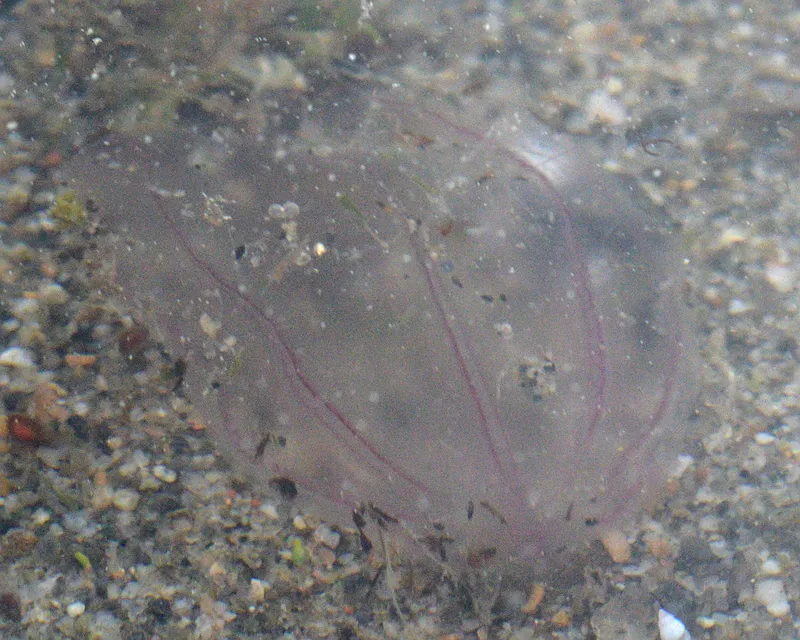
- What: A 1920s zoological sketch of a deep-sea comb jelly later appeared to closely match living ctenophores filmed by modern ROVs, showing that the old drawing captured real anatomy surprisingly well.
- Where: In the deep ocean.
- When: Originally in the 1920s, with confirmation coming in the late 20th and early 21st centuries.
For decades, a deep-sea comb jelly existed in two very different forms: as a careful drawing in an old zoologist’s sketchbook and, much later, as a real animal on modern underwater video. That contrast is what makes the story endure. A sketch that once looked speculative began to look precise only after remotely operated vehicles, or ROVs, finally filmed similar ctenophores alive in the deep ocean.
Why Early Comb Jelly Sketches Mattered
The object at the center of the story is not a dramatic fossil or a preserved specimen. It is a sketchbook image from the 1920s, made by a zoologist working with the limited tools of the era. Deep-sea animals were often damaged on the way to the surface, their soft bodies collapsing or tearing in nets. That made gelatinous life especially hard to study. Comb jellies, or ctenophores, are among the most fragile examples. Their shape, lobes, and trailing structures can be altered almost immediately once they are collected.
That is why some early illustrations mattered more than they seemed to at the time. A trained zoologist could record anatomical details before a specimen fully deteriorated, even if no camera could capture the animal alive in its habitat. In at least one often-retold case, a 1920s sketch of a deep-sea comb jelly appeared to match features later seen in live ROV footage: the overall body form, the arrangement of soft appendages, and the delicate geometry that is difficult to reconstruct from a ruined sample alone.
ROV Footage and Live Observations
The important point is not that the drawing proved anything impossible. It did not predict an unknown creature out of nowhere, and it was not evidence of a hidden world beyond science. More simply, it showed that careful observational work from an earlier period could be more accurate than later readers assumed. Once high-resolution deep-sea cameras became common in the late 20th and early 21st centuries, scientists could finally compare old descriptions with living animals in place, rather than with damaged remains on deck.
There is a wider context here. Deep-sea biology often advances in jumps created by technology. Trawls and jars produced one kind of knowledge. Submersibles and ROVs produced another. Soft-bodied animals especially benefited from that shift, because the camera could see them without destroying them first. In that sense, the old sketchbook was not ahead of science. It was waiting for the right instrument to be taken seriously.
Deep-Sea Biology and Technology
The hard fact is that live observations of many deep-sea comb jellies came largely after submersibles and ROV exploration made direct filming possible, and those images showed that some early 20th-century zoological sketches had captured real anatomical details with surprising accuracy decades earlier.
Did You Know?
Comb jellies move using rows of tiny cilia called comb plates, which create the shimmering rainbow effect often seen when light hits them.