
🚀 Whispers from the silent cosmos
Mir Space Station Fire: The 1997 Oxygen Generator Disaster
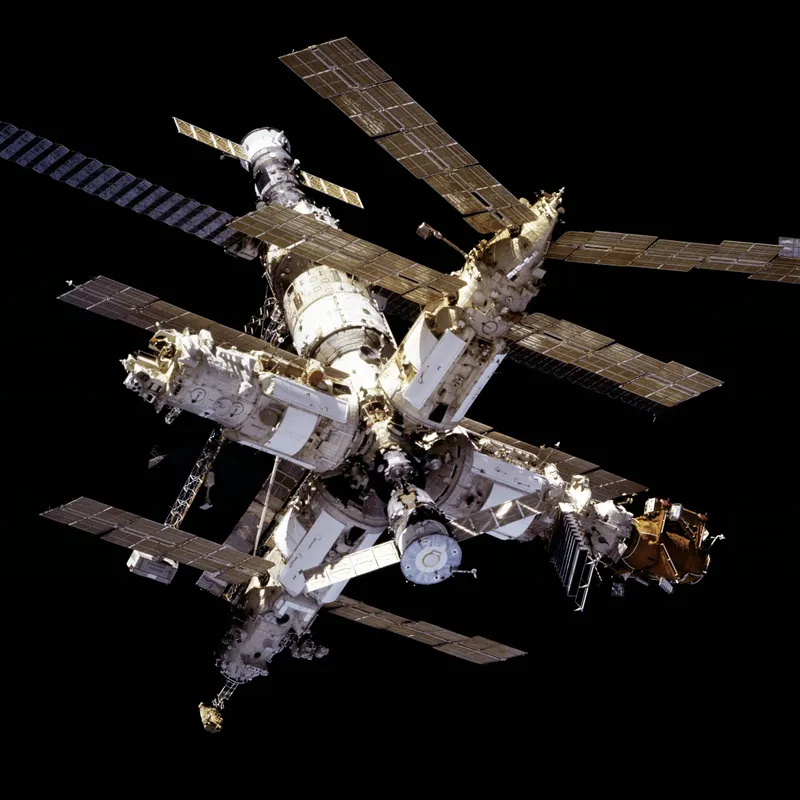
- What: A malfunctioning Vika backup oxygen generator on Mir ignited, triggering a dangerous onboard fire and smoke emergency that the crew had to contain.
- Where: Aboard the Mir space station in orbit.
- When: February 23, 1997.
Flames suddenly shot from a device that was supposed to keep the Mir space station alive. On February 23, 1997, during a routine activation of a backup oxygen generator aboard Mir, a solid-fuel canister malfunctioned and became one of the most dangerous onboard emergencies in human spaceflight.
Vika Oxygen Generator Fire
The fire came fast. The generator, known as a Vika chemical oxygen candle, was designed to produce breathable oxygen if the station’s primary systems had trouble. Instead, this one erupted with a jet of flame and a spray of hot particles. Smoke began spreading through the station’s modules. In microgravity, that mattered immediately: smoke does not rise away from people the way it does on Earth. It hangs, drifts, and fills the space where the crew has to work and breathe.
The crew had little room for error. Cosmonauts Vasili Tsibliyev and Aleksandr Lazutkin, along with NASA astronaut Jerry Linenger, moved to fight the fire while dealing with choking smoke and reduced visibility. Reports from the crew later described an intense, frightening scene. Some accounts say the flames burned for about 14 minutes. During that time, parts of the station were effectively cut off, and access to a docked Soyuz escape vehicle was at least partially obstructed by the location of the fire and the layout of the modules.
Mir Crew Emergency Response
Emergency procedures kicked in. The crew used respirators and fire extinguishers, isolated sections where necessary, and worked to keep the station habitable. They were not facing a cinematic explosion. The real danger was tighter than that: toxic smoke, heat, limited breathing gear, and the possibility that a station already under strain could tip into a cascading failure.
The event was especially unsettling because the source was not an experimental engine or a major collision. It was a backup life-support device. That is what gives the Mir fire its lasting force. In orbit, redundancy is supposed to buy time. Here, redundancy itself became the threat, and the margin between a contained incident and a full evacuation was thin.
Spacecraft Fire Safety Lessons
The consequence reached beyond one bad day on Mir. The fire became a hard lesson in spacecraft risk: even systems meant to save a crew can create a new emergency if they fail in the wrong way. When people talk about fire safety, escape paths, and life-support design on space stations today, the 1997 Mir oxygen-generator fire remains a concrete example of why those details cannot be treated as secondary.
Did You Know?
The Vika oxygen candle was a solid-fuel system, meaning it generated oxygen through a chemical reaction rather than from stored gas tanks.