
🛍️ Artifacts of human ingenuity
Pilot Watches With Slide Rule Bezels Explained
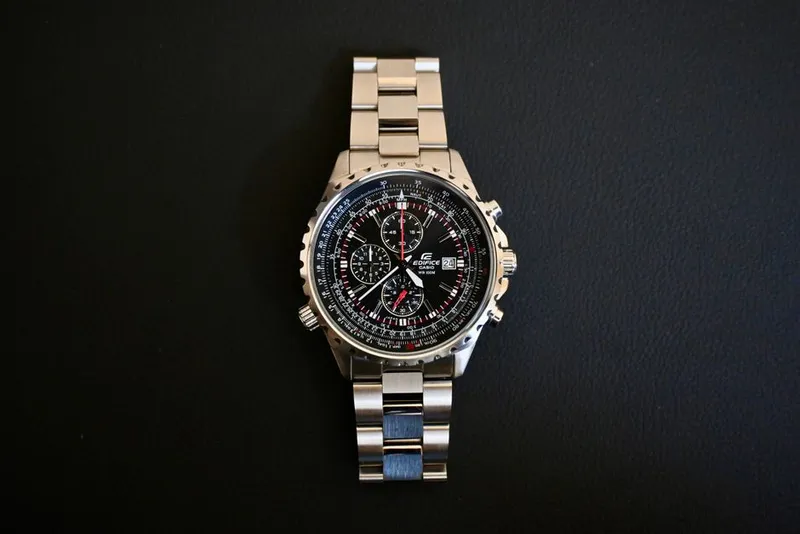
- What: The article explains how pilot watches with slide-rule bezels worked as wrist-sized analog calculators for flight-related math such as fuel use, unit conversion, speed, and distance.
- Where: In aviation cockpits and during flights.
- When: Most notably in the 1950s, before GPS became common.
Before GPS turned navigation into a glowing dot on a screen, some pilot watches put part of the job on the wrist. The key feature was not the dial itself, but the bezel: a tiny circular slide rule that could help a pilot handle in-flight calculations quickly.
How Slide Rule Bezels Worked
On certain aviation watches, most famously models associated with Breitling’s Navitimer line in the 1950s, the outer ring and inner scale worked together like a compact analog computer. Rotate one scale against the other, and the watch could help with practical math tied to flying. A pilot could estimate fuel consumption, convert units, work out speed against time, or make distance calculations without reaching for a separate tool.
The object matters here because, at a glance, a slide-rule bezel can look decorative. It is busy, technical, and easy to mistake for styling. In reality, it came from a very specific use case. Aviation in the mid-20th century still relied heavily on dead reckoning, radio navigation, printed charts, and cockpit instruments. Fast mental math was useful, and space inside a cockpit was limited. A wristwatch that could handle common calculations had real value.
This did not mean every luxury watch was a pilot instrument, or that every pilot depended on a watch bezel for navigation. Cockpit computers, paper flight computers, and onboard systems remained central. But the slide-rule watch occupied an interesting middle ground: portable, mechanical, and immediately accessible. It was less about romance than about reducing friction during a flight.
Circular Slide Rule Math
The underlying math was not mysterious. Circular slide rules use proportional scales, letting multiplication, division, and conversion happen by alignment rather than longhand calculation. On a wrist-sized bezel, that principle became compact enough to wear. The result was not perfect precision, but aviation often values fast, usable answers over excessive exactness, especially for routine planning and checks.
Why the Feature Mattered
The broader insight is that this watch feature came from a period when consumer products sometimes carried specialized professional functions directly in their physical design. The bezel was not an extra screen or hidden software mode. Its intelligence was visible on the surface, printed into metal and crystal, waiting for someone who knew how to use it.
That is what makes the pilot watch slide rule notable as a product. In an era before satellite navigation became ordinary, a small rotating bezel could help convert miles to kilometers, estimate fuel burn, or relate speed to time from the edge of a wristwatch. It was decoration only to people who did not need the math.
Did You Know?
The Breitling Navitimer is often cited as being introduced in 1952.