
🧩 Fragments from the unknown
Glosas Emilianenses and the Medieval Margins of Knowledge
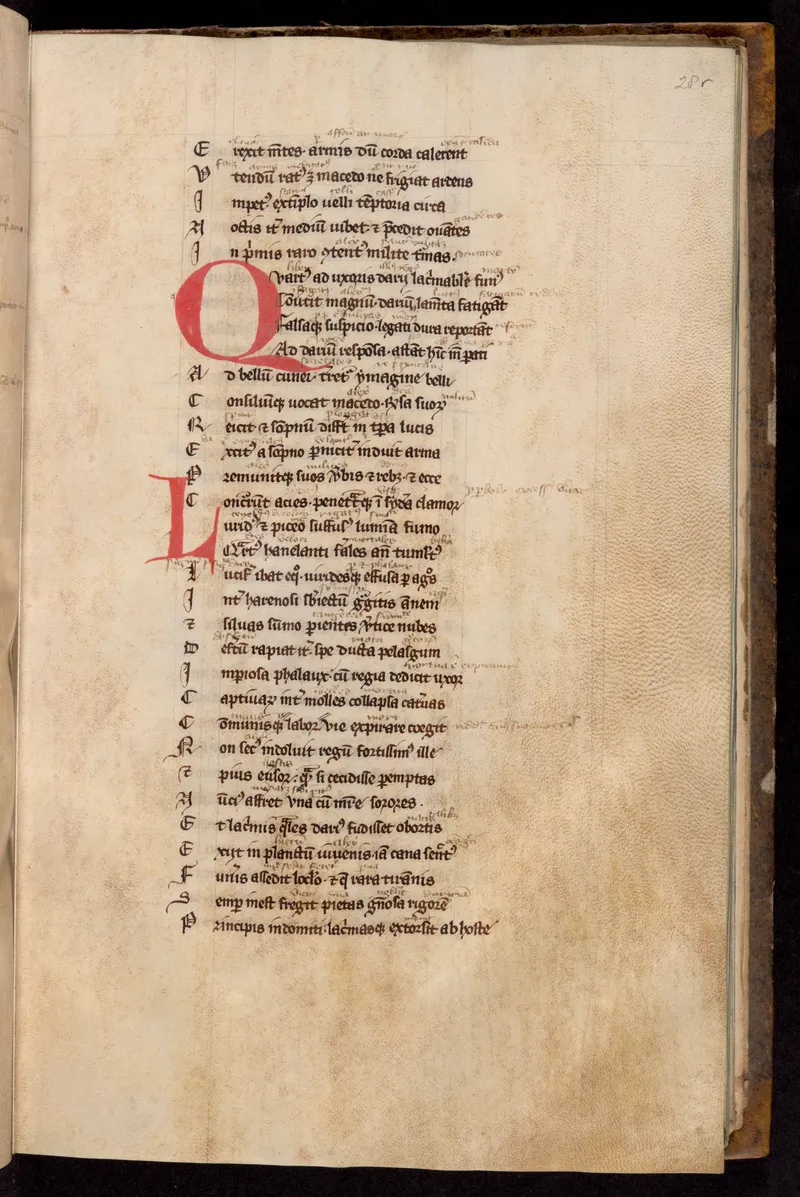
- What: The Glosas Emilianenses are a multilingual set of marginal and interlinear notes added by several readers to a Latin monastic codex, showing shared medieval reading and explanation rather than a single author’s text.
- Where: San Millán de la Cogolla in northern Spain.
- When: Around the 10th and 11th centuries.
The Glosas Emilianenses are not just notes in a book. They are a record of several readers, working at different moments in the 10th and 11th centuries, adding explanations in the margins of a monastic codex at San Millán de la Cogolla in northern Spain.
The Manuscript and Its Glosses
The object itself matters first. This was a manuscript already in use, copied in Latin, and then surrounded by glosses: short marginal and interlinear notes that helped readers make sense of difficult passages. Some are in Latin. Some appear in an early Romance variety associated with the region. Some are in Basque. The result is not a neat author’s statement. It is a layered page, with different hands leaving different traces.
That is what makes the manuscript so revealing. Modern readers often imagine a medieval book as a fixed object, written once and preserved. The Glosas Emilianenses show something more active. The codex was read, taught from, clarified, and revisited. Its margins became a working space where knowledge could accumulate over time.
Multilingual Margins in Use
This matters especially because the glosses are multilingual. They do not simply translate word for word in a mechanical way. They show readers responding to immediate needs: clarifying grammar, unpacking meaning, smoothing comprehension. In a monastery, that kind of annotation was practical. A difficult text needed to be usable. The margins helped make it usable.
There is also an important limit here. The glosses should not be treated as a single voice or a single moment of composition. Paleographic study points to several hands, and the manuscript’s significance comes from that plurality. What survives is evidence of shared reading rather than solitary authorship.
Shared Reading at San Millán
In context, that changes how the manuscript fits into cultural history. The Glosas Emilianenses are often discussed because of the history of early Romance writing, and because they preserve early written Basque material as well. But just as important is the social fact visible on the page: readers were building a small archive of understanding in the margins of a common book.
That concrete detail is the point. At San Millán de la Cogolla, the codex became more than a copied text. It became a layered tool shaped by repeated use, where medieval knowledge was not only preserved in the main script but added, corrected, and shared in the narrow space at the edges.
Did You Know?
The codex is often cited because some of its glosses are among the earliest known written examples of Spanish.