
🌍 Records from the halls of power
Donald Rumsfeld's "Unknown Unknowns" Quote Explained
There are known knowns; there are known unknowns; and there are unknown unknowns
- Who: Donald Rumsfeld, U.S. Defense Secretary.
- Where: At a Pentagon briefing.
- When: February 12, 2002, during the post-9/11 period.
- Why: It became memorable because it framed the problem of decision-making under incomplete information, especially amid Iraq intelligence debates.
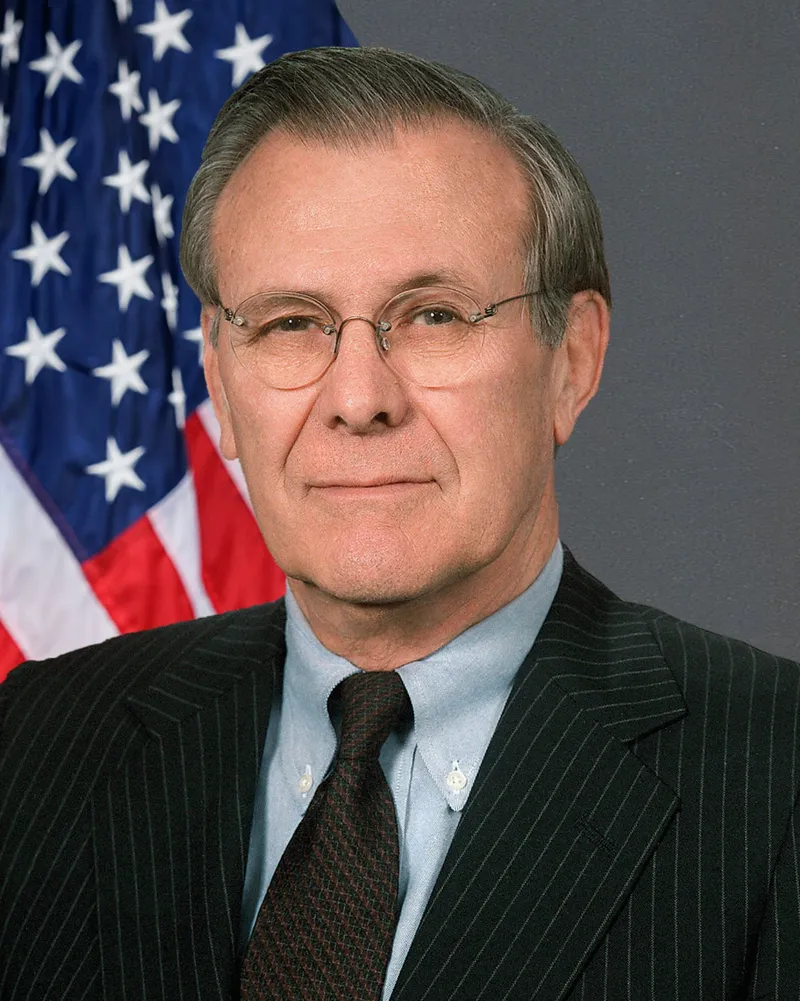
On February 12, 2002, at a Pentagon briefing, U.S. Defense Secretary Donald Rumsfeld gave one of the most remembered lines of the post-9/11 era: “There are known knowns; there are known unknowns; and there are unknown unknowns.” He was answering questions about intelligence and uncertainty surrounding Iraq. The sentence sounded awkward at first, but it stayed in public memory because it tried to name a real problem: decision-making under incomplete information.
What Rumsfeld Meant
That was why the quote mattered in the moment. Rumsfeld was not offering a slogan so much as a framework. Intelligence work is not simply a matter of having facts or lacking them. Some things are established. Some gaps are visible. And some dangers are not even recognized yet, which makes them harder to prepare for. In a defense setting, especially in the tense climate of early 2002, that distinction carried obvious weight. Governments were being pressed to explain what they knew, what they suspected, and how they justified action when certainty was impossible.
The line resonated because it compressed that problem into plain categories, even if the wording sounded clumsy. It was bureaucratic language, but it was also unexpectedly philosophical. People remembered it partly because it felt strange enough to repeat, and partly because it described something familiar: the unsettling fact that the biggest risks are sometimes the ones no one has properly identified. A press briefing answer became a phrase that could travel far beyond the Pentagon.
Iraq Intelligence and Uncertainty
Its durability also comes from the way it captured the pressure of that specific historical moment without being trapped inside it. The quote is closely tied to debates over intelligence on Iraq, and that association has shaped how many people hear it. But the phrase endured because it names a wider reality in politics, business, science, and everyday life. Plans often fail not only because known problems were mishandled, but because unseen problems entered the picture.
Why “Unknown Unknowns” Endured
That is why the sentence survived the briefing that produced it. Many official remarks vanish within hours. This one did not, because it gave a durable label to the limits of knowledge itself. Even now, when people use “unknown unknowns,” they are usually pointing to a concrete and serious idea: not just uncertainty, but uncertainty that cannot yet be clearly measured, questioned, or even fully imagined.
Did You Know?
The phrase “unknown unknowns” became a durable label for risks that have not yet been identified at all.