
🎭 Fragments from the heart of civilization
Edith Piaf's 1935 Paris Street Discovery Explained
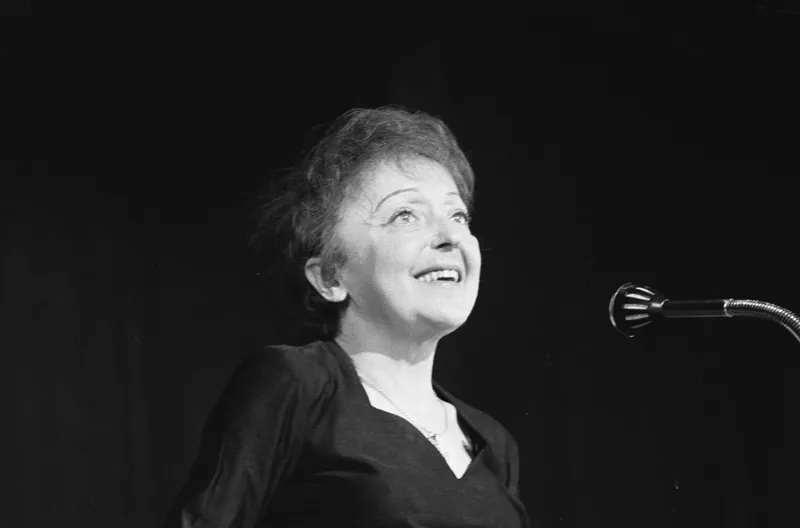
- What: Louis Leplée discovered Edith Piaf singing on the street, brought her into his cabaret Le Gerny’s, and helped launch her professional career under the name “La Môme Piaf.”
- Where: Paris, including a street corner and Le Gerny’s on the Champs-Élysées.
- When: 1935, with the aftermath continuing into 1936.
On a Paris street corner in 1935, a young singer was working for coins, cutting through the traffic with a rough, direct voice. That singer was Edith Piaf, and the man who stopped to listen was Louis Leplée, a nightclub owner whose decision changed the scale of her career almost immediately.
Louis Leplée and Le Gerny’s
The key event came first. Leplée heard Piaf singing in the street and brought her into his cabaret, Le Gerny’s, on the Champs-Élysées. He gave her a stage, a better-paying audience, and a name that would stick: La Môme Piaf, usually translated as “The Little Sparrow.” The nickname fit her slight build, but the bigger point was practical. Street singing had made her visible to passersby; cabaret made her visible to Paris.
That jump matters because Piaf did not arrive as a polished industry creation. Her early appeal was the contrast between size and sound: a compact performer with a voice that felt weathered, forceful, and close to the listener. In a nightclub setting, that intensity became legible as style rather than just survival. Leplée did not invent her voice, but he did place it where critics, customers, and talent brokers could hear it under lights instead of in the open air.
The story is often retold as a perfect instant discovery, and it is worth keeping it grounded. Piaf had already been singing publicly before Leplée found her. She was not transformed from nowhere in a single night. But 1935 was still the hinge. Leplée’s backing moved her from street performance into the center of Paris popular entertainment, where reputation could spread fast through clubs, press, and recordings.
Leplée’s Murder and Aftermath
There was also instability around that breakthrough. Soon after introducing her, Leplée was murdered in 1936. Piaf’s name was pulled into the scandal because of people from her earlier street-world connections, though she was not convicted of involvement. The episode could have ended her rise before it fully began. Instead, with help from songwriter Raymond Asso and others who reshaped her repertoire and image, she continued upward.
From Street Singing to Chanson
The broader context is what makes the moment so revealing. In interwar Paris, the distance between the street, the cabaret, and the recording studio was real but not impossible to cross. Piaf’s career shows how French popular music could absorb raw urban performance and turn it into national culture without smoothing away all of its edges.
So the concrete fact at the center remains sharp: in Paris in 1935, Louis Leplée heard Edith Piaf singing outdoors, brought her into Le Gerny’s, and helped shift her from busking into professional chanson. The voice was already there. What changed was who could hear it.
Did You Know?
Leplée’s murder in 1936 drew scrutiny toward Piaf, but she was not convicted in connection with it.