
🌿 Stories carved by wind and water
Ghost Orchid Reappears After Decades Underground in Europe
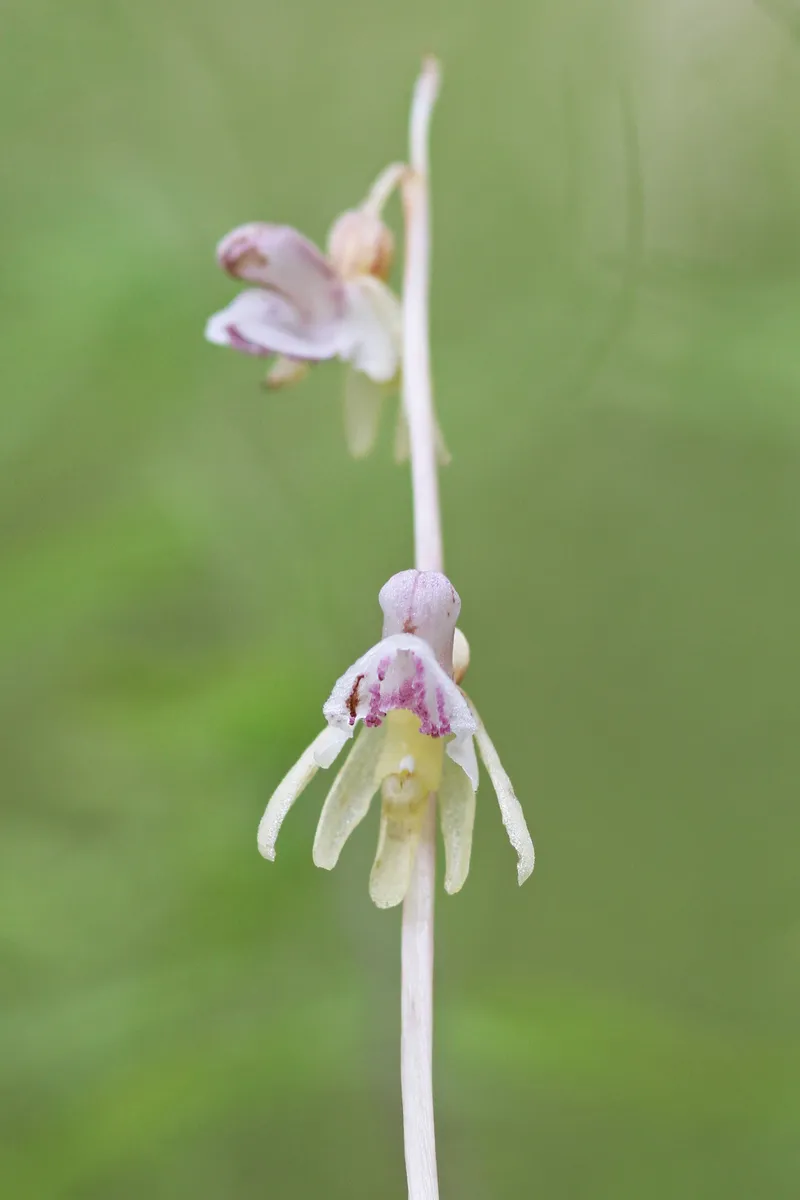
- What: The ghost orchid (Epipogium aphyllum) can stay hidden underground for years or decades and then reappear above ground in the same woodland site.
- Where: European woodlands, and parts of Asia.
- When: Its visible flowering phase may occur only after long gaps of many years.
The ghost orchid in Europe has a habit that sounds almost made up: it can disappear from a woodland for years, even decades, and then show up again in the same place.
How the Ghost Orchid Survives
This is Epipogium aphyllum, a rare orchid found across parts of Europe and Asia. It is pale, leafless, and easy to miss even when it does emerge. Most of its life is thought to happen out of sight. Instead of depending on green leaves to gather energy from sunlight, it relies on fungi underground. That unusual arrangement helps explain why a site can seem empty for a very long time without the plant necessarily being gone.
The key idea is simple, even if the biology is not. A plant does not have to be visible above ground to still be alive. In the case of the ghost orchid, botanists think long-lived underground rhizomes can persist in woodland soils while connected to fungal partners. In some years, no flowering stems appear at all. Then, under the right conditions, a stem pushes up through the leaf litter and the orchid is suddenly back on the record.
Why It Reappears After Decades
That pattern has been noted at European woodland sites where the species was believed to have disappeared locally, only for it to be found again later. The dramatic part is not that the plant traveled back in. It may have been there the whole time, hidden below the surface, waiting through years that offered no visible sign.
This matters beyond one unusual orchid because it complicates the idea of absence. In field botany, not finding a plant above ground is not always proof that it has vanished from a place. For species tied this closely to soil fungi, the visible phase may be only a brief episode in a much longer underground life. That makes records harder to interpret and conservation status harder to judge at the scale of a single site.
Conservation and Hidden Dormancy
Even so, there is some uncertainty in the details. Researchers broadly accept the orchid’s dependence on fungi and its capacity for long hidden intervals, but exactly what triggers reappearance at a given site is less clear. Weather, forest conditions, and fungal dynamics may all play a role.
So the ghost orchid remains compelling for a very plain reason. A patch of European woodland can look empty for many years and still hold Epipogium aphyllum below the soil, alive but unseen, until one season it decides to become visible again.
Did You Know?
Epipogium aphyllum is often called a “mycoheterotroph” because it gets its carbon through fungi rather than through photosynthesis.