
🌍 Records from the halls of power
Mount Erebus Lava Lake in Antarctica Explained
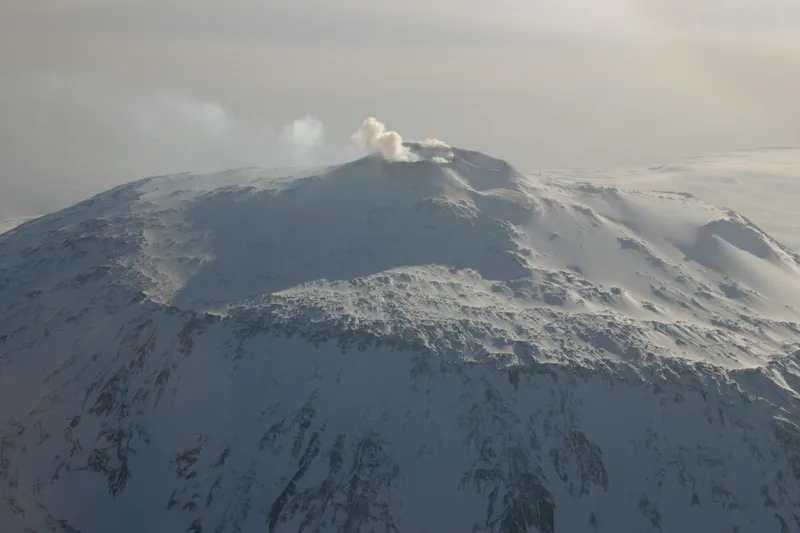
- What: Mount Erebus is a rare Antarctic volcano with a persistent lava lake, a steady gas plume, and frequent small explosions that scientists monitor over time.
- Where: Ross Island in Antarctica.
- When: Ongoing, with observations made during seasonal field campaigns.
Mount Erebus, on Ross Island in Antarctica, is one of the few volcanoes on Earth with a persistent lava lake. Instead of erupting in one dramatic burst and then going quiet, it holds a long-lived pool of molten rock near its summit crater, sends up a steady gas plume, and produces frequent small explosions that researchers can track over time.
That combination is what makes Erebus important. Many volcanoes are studied through short eruptions or indirect measurements. Erebus offers something rarer: a system that stays active for years, letting scientists return during seasonal field campaigns and compare what changed and what did not. The lava lake acts like a visible window into the behavior of magma and volcanic gases.
How Scientists Study Erebus
The setting is severe, but the scientific value is very practical. Teams working from seasonal camps and supported by Antarctic research logistics have monitored Erebus with cameras, seismic instruments, gas sensors, and direct observations. They watch for strombolian-style bursts, measure gas output, and study how the surface of the lava lake circulates and crusts over before breaking again. Because the activity is persistent rather than brief, patterns can be documented instead of guessed.
Mount Erebus Phonolite Lava
Erebus is also unusual for its chemistry. It erupts a type of lava called phonolite, which is less common than the basalt associated with many famous lava lakes. That matters because different magma compositions affect gas release, viscosity, and explosion style. A persistent lava lake in this kind of volcano gives researchers a chance to test ideas that would be harder to examine at more short-lived or less accessible systems.
Why Erebus Is Significant
The key insight is its rarity. Only a small number of volcanoes are known to host persistent lava lakes at any given time, and not all of them can be observed repeatedly in the same way. Erebus is valuable not because it is the biggest or most violent, but because it stays active in a relatively consistent form long enough for close, repeated measurement.
So the significance of Mount Erebus is concrete: on the edge of Antarctica, scientists have a rare natural laboratory where a lava lake, gas plume, and frequent small explosions can be monitored season after season, improving how volcanic behavior is measured and understood.
Did You Know?
Mount Erebus is one of the southernmost active volcanoes on Earth.