
🎭 Fragments from the heart of civilization
Saint Spyridon's Slippers in Corfu and What They Mean
- What: The article explains the Corfu tradition of placing and replacing slippers on the relics of Saint Spyridon, then sharing pieces of the worn pairs with pilgrims as blessings.
- Where: Corfu Town, on the Greek island of Corfu.
- When: Rooted in long-standing Orthodox tradition centered on a fourth-century saint.
In Corfu, the relics of Saint Spyridon are associated with something unusually ordinary: slippers. At the saint’s church in Corfu Town, pairs of slippers are traditionally placed on the relics and replaced when they become worn. Pieces of the older pairs are then given to pilgrims as blessings.
Why Saint Spyridon’s Slippers Matter
It is a small object, easy to miss beside the silver casket and the long history attached to the island’s patron saint. But the slippers carry a very specific local meaning. Saint Spyridon, a fourth-century bishop especially venerated in the Greek Orthodox world, is believed by the faithful to continue protecting Corfu. The worn slippers fit into that belief in a practical, tactile way. They suggest movement, care, and nearness, not as abstract ideas but as leather and cloth that can fray, be changed, and be touched.
The practice is often explained through devotion rather than proof. Believers connect the worn footwear to the saint’s ongoing help in Corfu’s history, especially during times when he was credited with saving the island from danger, including plague and siege. There is no definitive proof in the modern historical sense for why slippers wear out in a reliquary setting, and the church tradition does not rest on laboratory explanation. What matters in practice is that the old slippers become contact relics: material items linked to a saint through proximity and ritual use.
Slippers as Contact Relics
That detail helps explain why the custom has lasted. Relic veneration can sound distant when described only in theology or art history. In Corfu, it becomes lived religion through an object made for feet. A pilgrim does not encounter only a story about a saint from late antiquity. They may receive a small piece of worn fabric from a slipper, something humble enough to fit in the hand and specific enough to tie devotion to a place, a church, and a continuing local tradition.
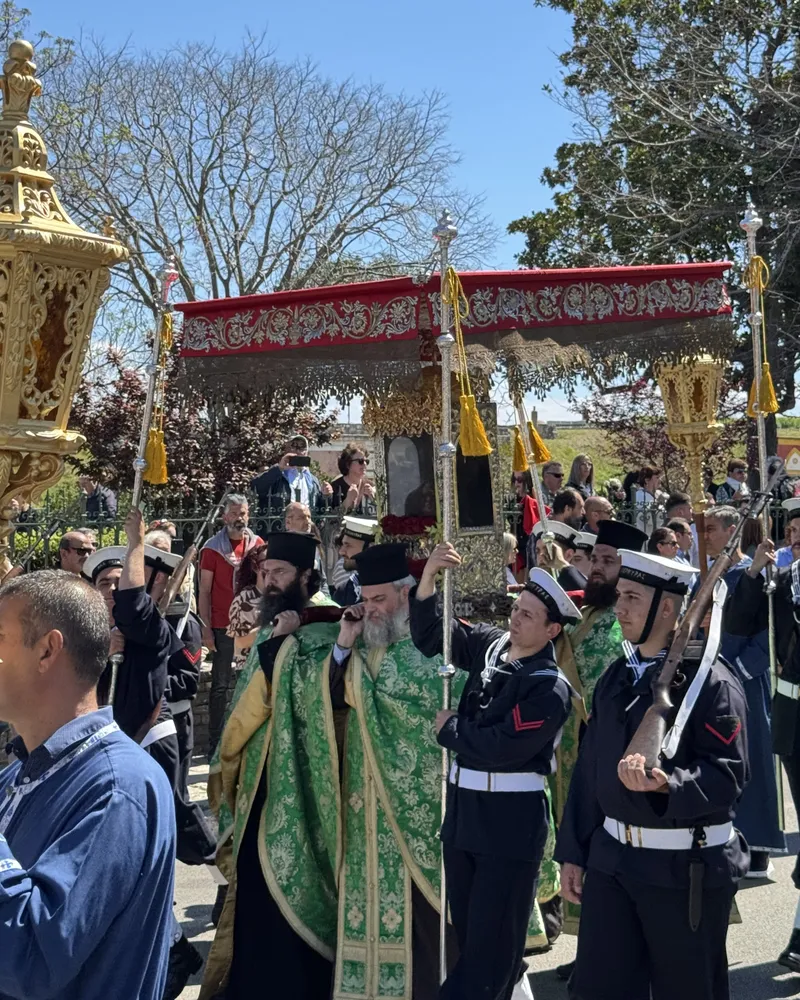
Seen in context, the slippers say something important about Corfu itself. The island’s religious culture has long woven public memory, civic identity, and Orthodox devotion together, with Saint Spyridon at the center. The saint’s feast days and processions are part of that larger setting. The slippers are not a spectacle apart from it; they are one of the clearest examples of how a community keeps holiness close to daily life.
Corfu Tradition and Pilgrim Blessings
That is why the worn pairs matter. In Corfu, they do not remain stored away as old shoes. They are cut, shared, and carried off in small pieces, turning a pair of slippers into a concrete blessing tied to the island’s patron saint.
Did You Know?
Saint Spyridon is also widely revered in the Greek Orthodox Church as the patron saint of potters.