
🧩 Fragments from the unknown
Boston Molasses Flood of 1919 Turned Streets Deadly
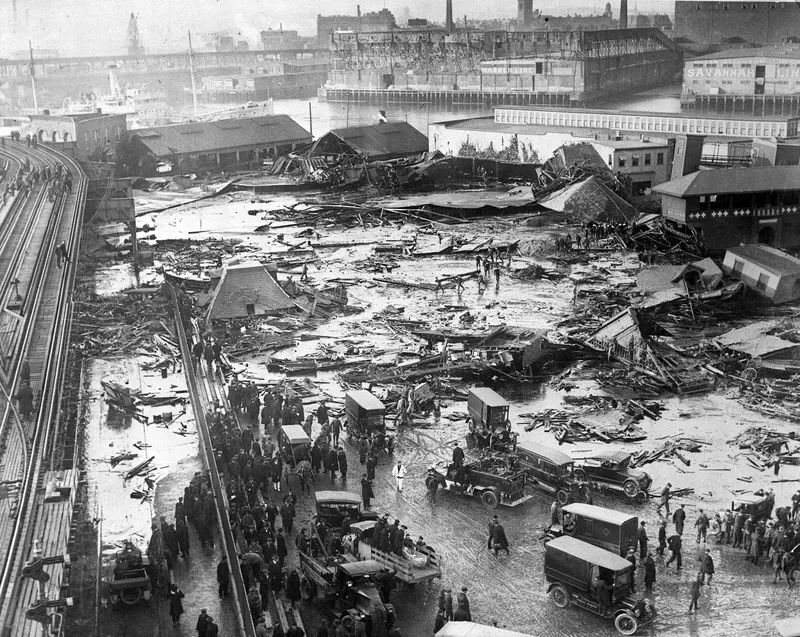
- What: The 1919 Boston Molasses Flood was a fatal industrial disaster in which a storage tank burst and sent a wave of molasses through the streets.
- Where: Boston’s North End, especially Commercial Street.
- When: January 15, 1919.
At lunchtime in Boston’s North End on January 15, 1919, people heard a deep rumble and then saw something that made no sense. A giant storage tank owned by the Purity Distilling Company burst, and a wall of molasses rushed into the streets.
How the Molasses Flood Hit Boston
This was not a slow spill. Witnesses described a fast-moving wave of thick, dark syrup tearing through Commercial Street, ripping apart buildings, smashing wagons, and tossing debris into the air. Some reports said the surge reached about 25 feet high at its peak, though details vary by account. What is clear is that it hit with enough force to wreck parts of the neighborhood in seconds.
The disaster killed 21 people and injured around 150. Some victims were struck by flying timber, metal, and collapsing structures. Others were trapped and unable to breathe in the dense flood. Rescue was brutally difficult. Molasses coated the ground, the wreckage, and the people trying to pull survivors free. In winter cold, the syrup thickened, turning the scene into a heavy, adhesive mass that slowed every movement.
Why the Storage Tank Burst
The tank had held millions of gallons of molasses, which was used to make industrial alcohol, a valuable commodity at the time. Investigations and later court findings pointed to a combination of problems: poor construction, possible overfilling, and rising internal pressure, potentially worsened by a recent delivery of warmer molasses. The exact mechanics have been debated in detail, but the broader conclusion was not mysterious. This was an industrial failure, not an unavoidable act of nature.
That is what makes the Boston Molasses Flood so disturbing. It felt like a freak urban tsunami, yet it began with bolts, steel plates, and corporate decisions. A familiar city block became a disaster zone because a storage tank was not safe enough to hold what it contained.
Legacy of the 1919 Disaster
The consequences reached beyond the wreckage. The case helped push stricter scrutiny of large industrial structures, including engineering review and permitting practices. Today, the 1919 molasses flood is remembered not just for its strangeness, but for a specific fact: in the middle of Boston, a tank failure created a lethal wave that killed people in the street.
Did You Know?
The disaster led to a long legal battle, and the company was ultimately held responsible for the tank’s failure.