
🏺 Recovered from the dusty archives
7 Iconic Structures With Dangerous Design Decisions
- What: This list highlights major engineering and architectural failures or hazards caused by seemingly small design choices, geometry effects, or connection changes that produced outsized consequences.
- Where: Primarily major urban buildings and bridges in the United States, the United Kingdom, and South Korea.
- When: Mostly 20th- and early 21st-century engineering and construction case studies.
Some landmark failures start with something dramatic: a collapse, a closure, a panic retrofit. But often, the real trigger is much smaller than people expect.
These seven history and engineering stories all turn on one design choice, geometry problem, or connection detail that created consequences far bigger than it appeared on paper.
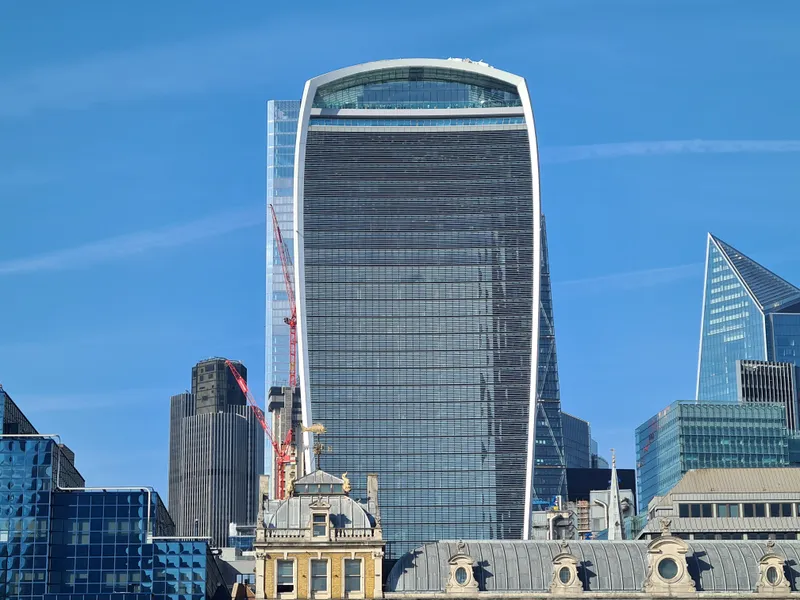
1. The ‘walkie-talkie’ that melted car parts
At 20 Fenchurch Street in London, the building’s concave glass façade did something its nickname never warned about: it concentrated sunlight onto the street below. On Eastcheap, that focused heat reportedly blistered car trim and warped panels.
What makes it so striking is how ordinary the feature seemed. A glass curve became a solar reflector powerful enough to force a fix, with permanent brise-soleil and film added to diffuse the reflections.
2. Vdara’s pool ‘death ray’
In Las Vegas, Vdara’s curved, reflective geometry turned the hotel into an unexpected sun concentrator. At the pool deck, focused sunbeams caused minor burns and even melted plastic.
The hazard sounded almost too strange to be real, which is why it spread so widely. Management responded with shade structures and window film, turning a luxury design feature into a cautionary engineering lesson.
3. Why London’s Millennium Bridge bounced and closed
When the Millennium Bridge opened in London in 2000, pedestrians felt something no one wants from a bridge: lateral sway. As crowds walked, footfalls synchronized on the flexible deck, amplifying the motion.
The surprise was that people were not just reacting to the movement; they were feeding it. Engineers closed the bridge, then added viscous dampers and tuned mass dampers before it reopened.
4. Galloping Gertie: a bridge that danced itself apart
The Tacoma Narrows Bridge became famous in 1940 for moving in a way bridges were never supposed to move. In steady winds, aerodynamic instability produced torsional flutter.
The bridge’s collapse changed more than one crossing. It became a defining lesson in bridge aerodynamics and structural design, showing how wind itself could interact catastrophically with a structure’s form.
5. The Sampoong mall where a roof became fatal
The Sampoong Department Store collapse in Seoul in 1995 was tied to unauthorized design and construction changes with devastating consequences. Columns were removed, a fifth floor with restaurants was added, and heavy rooftop HVAC increased the load on weakened supports.
That combination turned the roof and upper structure into a fatal chain reaction. The story remains one of the starkest examples of how altered plans and added weight can push a building past its limits.
6. Hyatt walkway: a hanger-rod connection change with huge casualties
At the Hyatt Regency in 1981, the disaster came down to a connection detail. A shop-drawing revision changed continuous hanger rods into two rods, a move that doubled the load on the box-beam connections.
The result was catastrophic when the atrium walkways collapsed. It stands as one of America’s deadliest structural failures, driven not by a giant, visible flaw, but by a seemingly technical change with enormous consequences.
7. The Midtown tower bolted into crisis
New York’s Citicorp Center faced a serious problem in 1978 when its chevron-brace joints were found to use bolted connections vulnerable under quartering winds. The issue was alarming because the danger was embedded in the frame itself.
Crews then welded steel plates overnight to strengthen the structure. The retrofit became nearly as famous as the building, not for public spectacle, but for how urgently a hidden structural weakness had to be addressed.
Across these cases, the pattern is hard to miss: a curve, a load path, a wind assumption, a revised connection. Small decisions did not stay small for long.
Did You Know?
The Millennium Bridge is often nicknamed the “Wobbly Bridge,” a name it picked up immediately after its swaying opening.