
🌍 Records from the halls of power
Harry Truman and the Meaning of The Buck Stops Here
The buck stops here
- Who: Harry S. Truman.
- Where: On a sign on his White House desk.
- When: During his presidency from 1945 to 1953.
- Why: It became a durable shorthand for presidential accountability, expressing Truman’s view that final responsibility for national decisions rested with the president.
“The buck stops here” is one of the most durable political phrases in American history because it turned a plain expression into a public statement about presidential power. It is most closely associated with Harry S. Truman, who kept the words on a sign on his White House desk during his presidency. In that setting, the phrase was not just a slogan for display. It summed up Truman’s view that the president had to accept final responsibility for national decisions.
Origin of The Buck Stops Here
The wording came from an older American expression. In card games, a marker called the “buck” could be passed to indicate whose turn it was to deal, and “pass the buck” came to mean shifting responsibility to someone else. Truman’s version reversed that idea. The buck did not move any farther. It stopped at the president’s desk.
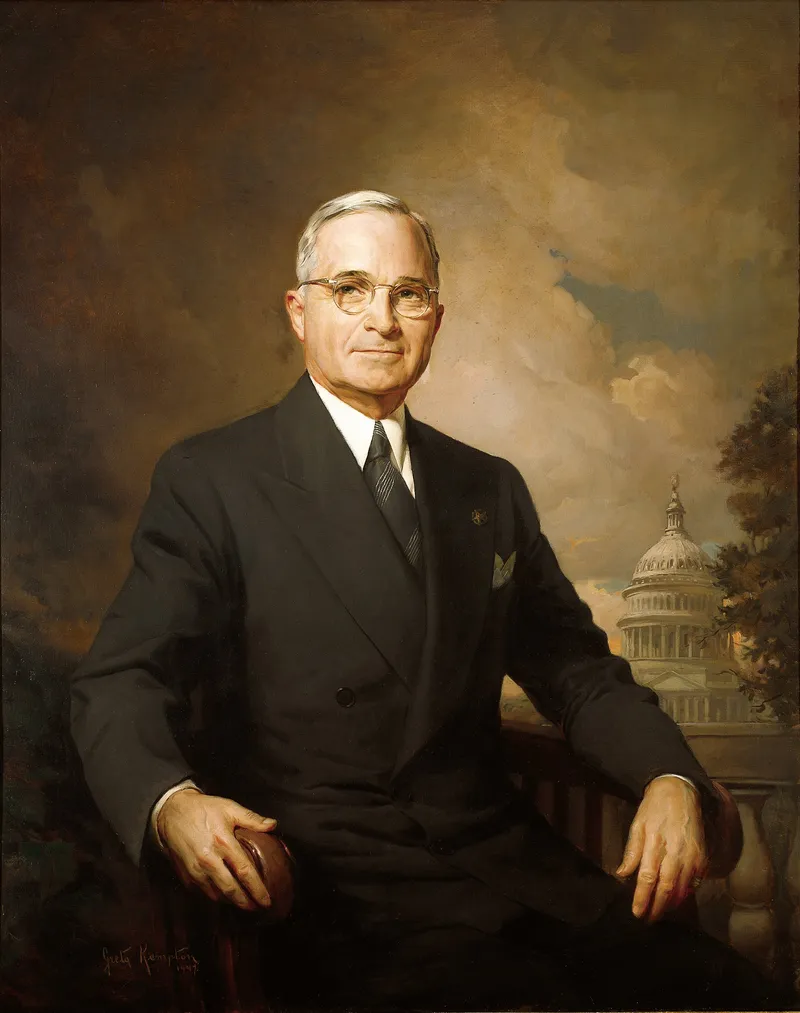
Truman and Presidential Responsibility
That mattered in the world Truman governed. He was in office from 1945 to 1953, a period defined by decisions with enormous stakes: the final phase of World War II, the opening years of the Cold War, military action in Korea, labor conflict at home, and the expansion of presidential responsibility in a more dangerous international order. In that environment, the sign offered a compressed theory of executive duty. It said that however many advisers, departments, generals, and agencies stood between a problem and the Oval Office, the final answer belonged to the person at the top.
The phrase resonated because it was blunt, memorable, and easy to test against events. Truman was not offering an abstract meditation on leadership. He was attaching himself to a standard that people could judge. If a major policy succeeded or failed, the sign implied that he would not hide behind subordinates. That did not make every decision popular, and it did not settle debates over whether his choices were right. But it gave the public a clear principle: accountability had an endpoint.
Why the Phrase Endured
Its endurance also comes from its physical form. A short sentence on a desk sign is easy to photograph, repeat, and quote. It reduced a constitutional idea to everyday language. Americans did not need specialized knowledge of government to understand it. The image did part of the work: the president at a desk, the sign in view, responsibility made visible.
That is why “The buck stops here” is still remembered. Not because it solved the moral difficulty of presidential decisions, and not because it turned Truman into a mythic figure, but because it named a real expectation of office in the clearest possible terms. A small sign on a White House desk became a lasting shorthand for the point beyond which blame could not be passed.
Did You Know?
The phrase reversed the older expression “pass the buck,” which meant shifting responsibility to someone else.