
🎭 Fragments from the heart of civilization
Utagawa Kuniyoshi's Earth Spider and Edo Political Satire
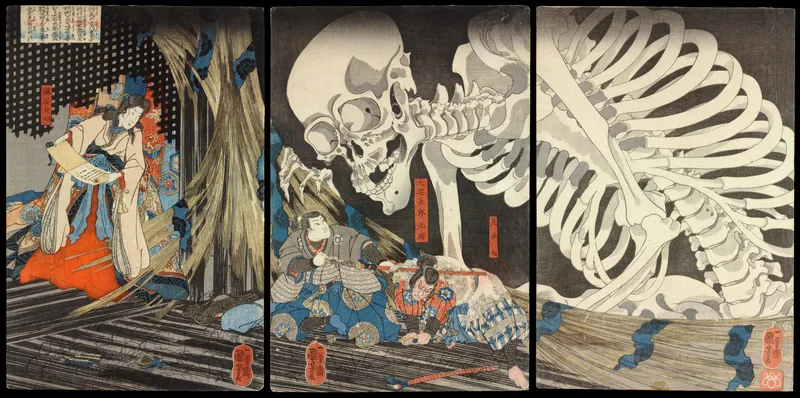
- What: Utagawa Kuniyoshi’s 1843 triptych Earth Spider is presented as a visually dramatic Edo-era print that also functioned as political satire under censorship.
- Where: Edo, Japan.
- When: c. 1843, during the Tenpō Reforms.
Around 1843, Utagawa Kuniyoshi released a triptych now often called Earth Spider, and the first thing viewers saw was not politics. It was a burst of action: a giant spider, sheets of web, and a room crowded with attacking monsters. The print is loud, theatrical, and easy to read as pure spectacle.
Tenpō Reforms and Edo Censorship
That surface mattered. Kuniyoshi was working in Edo during the Tenpō Reforms, when the shogunate tightened controls on luxury, entertainment, and publishing. Censors were active. Direct criticism was risky. Artists and publishers did not simply stop communicating, but they often shifted into safer-looking forms: historical subjects, legends, warrior tales, and visual allusion.
Earth Spider fit that world perfectly. The triptych draws on an older story about Minamoto no Raikō, the famous warrior, confronting a monstrous spider. Kuniyoshi filled the scene with yokai and ghostly figures pouring into the room. They are memorable as creatures, but they also gave viewers a second level of meaning. In Edo, many people were used to reading prints for references, substitutions, and jokes. The monsters could be understood as more than monsters.
Earth Spider as Political Satire
That is why the triptych is so often discussed as political satire. Rather than showing named officials or stating a complaint outright, Kuniyoshi used allegory. The threatening figures have long been read as standing in for the social strain and human suffering associated with the Tenpō Reforms. This was not necessarily “secret” in the modern conspiratorial sense. The point was not to hide a coded manifesto in plain sight. It was to work within a visual culture where suggestion, indirection, and shared recognition were already normal parts of printmaking.
That context matters because Edo satire did not always look like open protest. It often moved through familiar stories and commercially popular images. A supernatural attack scene could carry commentary precisely because it belonged to accepted genres. Kuniyoshi’s skill was not just that he painted monsters well. It was that he made a conventional subject do double duty, satisfying audiences who wanted drama while also giving them a way to think about current pressures without naming them directly.
Allegory Under Censorship
So the lasting interest of Earth Spider is very concrete: in one Edo print from around 1843, a legendary battle scene became a practical vehicle for commentary under censorship. The demons did not replace the story. They made the story usable for its moment.
Did You Know?
Earth Spider is one of Kuniyoshi’s best-known works and belongs to the ukiyo-e tradition of woodblock prints.