
🫀 Secrets of the human vessel
SV40 in Early Polio Vaccines Changed Virus Screening
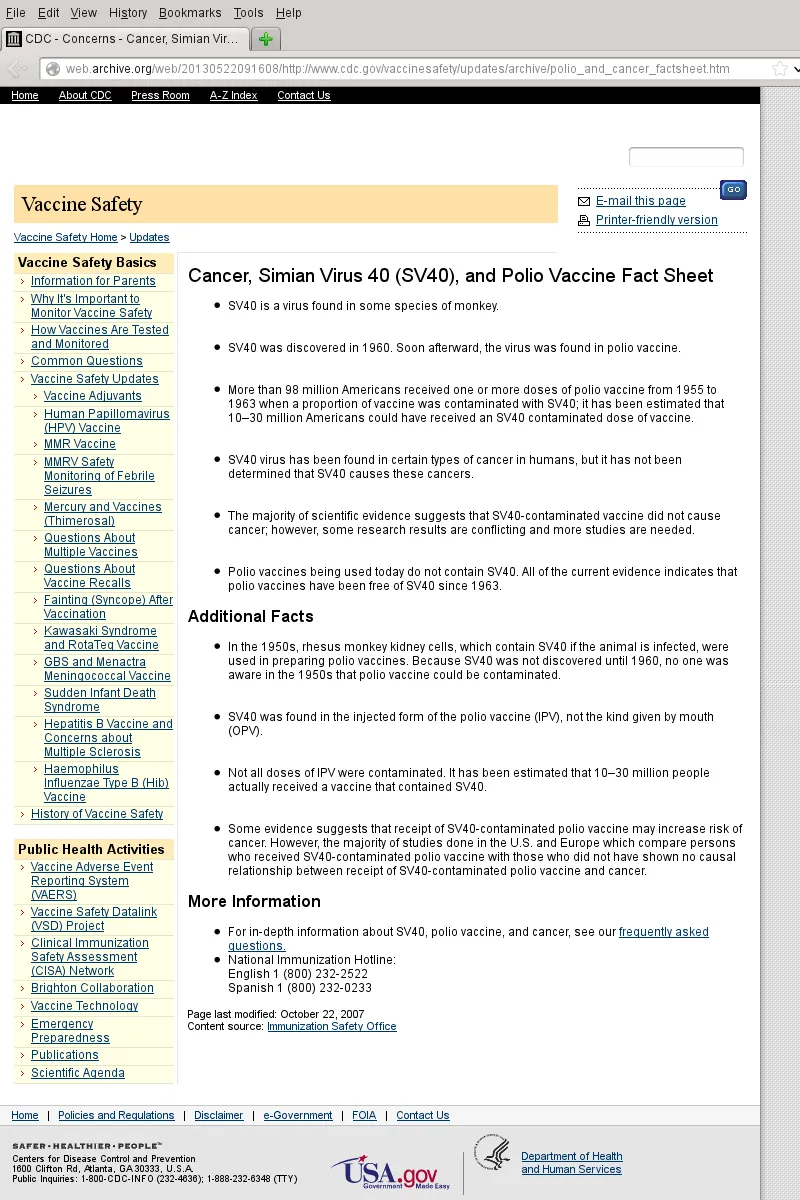
- What: Some early polio vaccine lots were contaminated with simian virus 40 (SV40) from monkey kidney cells, prompting stronger screening and viral safety standards for biological products.
- Where: The United States and other places using polio vaccines.
- When: Late 1950s and early 1960s.
In the late 1950s and early 1960s, some early polio vaccine lots contained an unexpected passenger: simian virus 40, or SV40. The contamination was not part of the vaccine itself. It came from monkey kidney cells used to grow the virus for vaccine production, and its discovery quietly changed how biological products are tested.
How SV40 Entered Polio Vaccines
The sequence mattered. Polio was one of the most feared diseases in the United States and beyond, and the race to produce effective vaccines was urgent. At the time, manufacturers used rhesus monkey kidney tissue to grow poliovirus for the inactivated Salk vaccine and, later, in some oral vaccine production. Then researchers identified SV40, a monkey virus, in 1960. Once scientists knew it existed, they realized some vaccine lots made before improved screening could contain it.
That did not mean all polio vaccines were contaminated. It meant some lots, during a specific period, were produced before labs had the tools and knowledge to detect this particular virus. After the discovery, testing methods changed. Manufacturers and regulators began screening monkey kidney cell cultures more carefully and moved toward safer, more controlled substrate systems over time.
SV40 Cancer Studies and Risk
SV40 drew attention because in laboratory settings it could affect cells in striking ways. But the bigger public-health story is not a hidden disaster narrative. It is a quality-control story. Researchers spent decades studying whether the contaminated vaccine lots caused cancer in people, and no definitive proof established that exposure from those vaccines caused cancer in humans. That uncertainty is important to state plainly.
Vaccine Screening Standards After SV40
The real consequence was procedural and lasting. The episode helped push vaccine science toward more rigorous viral safety standards: better screening of source animals, tighter control of cell substrates, and more formal oversight for biological products. In other words, a contamination event from the early vaccine era reshaped the rules for how hidden viruses are searched for before a product reaches the public.
That is why this little-known SV40 episode still matters. Its most concrete legacy is visible not in the old polio lots themselves, but in the modern screening systems built to catch contaminants earlier, more systematically, and with far better tools than vaccine makers had in 1955 or 1960.
Did You Know?
SV40 was first identified in 1960, which helped explain why earlier vaccine lots had escaped detection.