
🌿 Stories carved by wind and water
6 Plants That Borrow Animal Behaviors to Survive
- What: This list highlights plants that exploit animal behavior for key functions such as seed dispersal, pollination, and nutrient gain.
- Where: Natural ecosystems worldwide.
- When: Ongoing natural ecological interactions.
Some plants do not just wait for wind, rain, or luck. They turn animal habits into practical tools.
Across dispersal, pollination, and nutrition, these plants use birds, insects, ants, rodents, and even human clothing to get jobs done with startling precision.
1. Mistletoes ‘planted’ by birds wiping sticky seeds on branches
Mistletoe fruits can leave seeds coated in sticky viscin after birds eat them. That glue-like coating clings to the bird, especially around the beak.
The strange part is what happens next: birds wipe their beaks on perches and branches, smearing the seed directly onto a future host. A casual cleanup motion becomes seed planting.
2. Burdock and human clothing (Velcro origin)
Burdock does not need to chase anything. Its burs are built to latch onto passing fur and fabric with tiny hooks, turning movement into transport.
That simple hitchhiking design became famous for another reason: it inspired Velcro after the hooks were noticed clinging to clothing. A seed-dispersal trick crossed into human invention.
3. Orchids that mimic female insects to borrow mating energy
Some orchids pull off one of the most unsettling pollination strategies in nature. They mimic female insects closely enough to trigger attempted mating by males.
During that mistake, the insect picks up or delivers pollinia. The flower is not offering a reward so much as hijacking courtship behavior and turning it into pollination machinery.
4. Ant-plants using ants as living fertilizer spreaders
Myrmecophytes house ants inside hollow stems or domatia, creating built-in shelter for a colony. The ants move in, patrol, and bring debris with them.
What matters for the plant is the waste. Ant deposits and accumulated material become nutrients the plant absorbs, effectively outsourcing part of its fertilization to resident insects.
5. Seeds designed to exploit rodent caching behavior
Many plants produce seeds or nuts that rodents carry off and hide in scattered caches. For the animal, it is food storage for later.
For the plant, it is a gamble that often pays off. Some buried stores are forgotten, and those abandoned caches can germinate, turning hoarding into dispersal and planting at the same time.
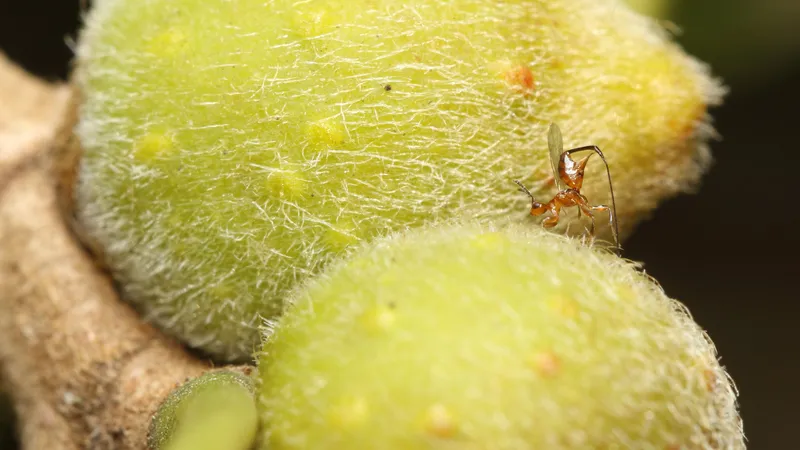
6. Figs using fig wasp life cycles as pollination machinery
Figs hide their flowers inside enclosed structures, which means ordinary pollination does not work. Instead, they depend on specific fig wasps whose life cycles fit the fig’s structure.
As the wasps enter, lay eggs, and later emerge, pollen gets transferred with remarkable accuracy. The result is a tightly tuned system in which the insect’s entire routine doubles as the fig’s pollination method.
Taken together, these plants make one thing clear: in nature, survival is often less about brute force than about finding the exact animal habit you can turn to your advantage.
Did You Know?
The term “myrmecophyte” for ant-plants comes from Greek: “myrmex” means ant, and “phyton” means plant.