
🌍 Records from the halls of power
Oosterschelde Storm Surge Barrier Preserves Tides by Design
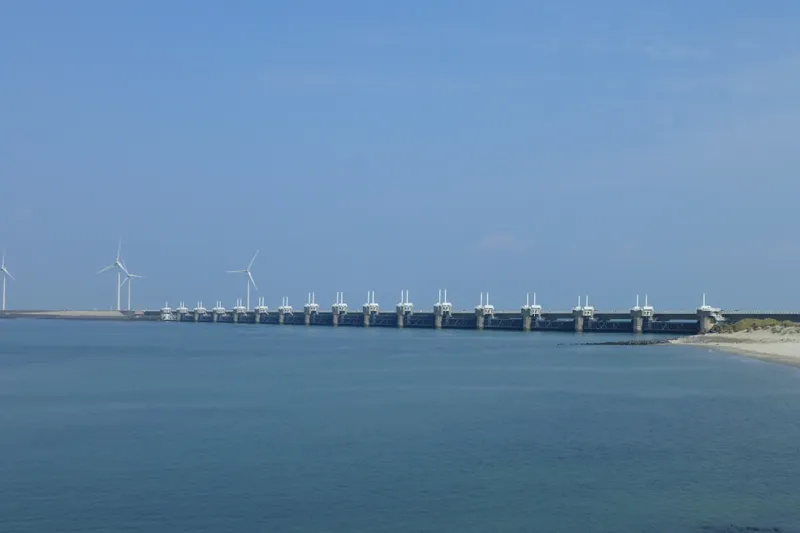
- What: The Oosterschelde storm surge barrier in the Netherlands uses movable gates to block storm surges while usually helping to maintain tidal flow and the estuary’s ecology.
- Where: The mouth of the Oosterschelde estuary in the Netherlands.
- When: Completed in 1986 as part of the Delta Works, after the 1953 North Sea flood.
The Oosterschelde storm surge barrier in the Netherlands was not built as a simple wall against the sea. It was designed with movable gates so the estuary could stay connected to the North Sea most of the time, while still closing during dangerous storm surges.
That choice mattered because the Oosterschelde was, and is, a living tidal system. Salt water moves in and out. Currents reshape channels and mudflats. Marine life depends on that rhythm. If engineers had sealed it off completely after the 1953 North Sea flood, the area would have become something very different: less tidal, less salty, and far less suited to species that rely on estuary conditions.
So the final design, completed in 1986 as part of the Delta Works, took a more complicated path. The barrier stretches across the mouth of the Oosterschelde with large openings between piers. Under normal conditions, those openings allow seawater and tides to pass through. When a severe storm threatens, the gates can be lowered to reduce the risk of flooding inland.
This is the part many people miss. The barrier was not mainly about choosing safety instead of nature, or nature instead of safety. It was an attempt to keep both, even though that meant accepting a more complex structure than a closed dam. Preserving tidal flow helped protect the estuary’s ecology, including shellfish areas and fish habitats tied to moving salt water.
That does not mean the system stayed untouched. Changing the mouth of an estuary changes currents and sediment movement, even when tides are still allowed through. But the project’s core idea was unusually specific: do not just block the sea; preserve enough of its natural pulse for the Oosterschelde to remain an estuary rather than turning into a static basin.
In concrete terms, the movable gates mean the barrier spends most of its life open, letting the sea in and out, and only becomes a flood defense in the moments it is actually needed. That is what makes the Oosterschelde barrier distinctive: it was built not simply to stop water, but to decide when not to.
Did You Know?
The Oosterschelde barrier is often described as the largest storm surge barrier in the world.