🌍 Records from the halls of power
5 Train Routes That Cross a Break of Gauge
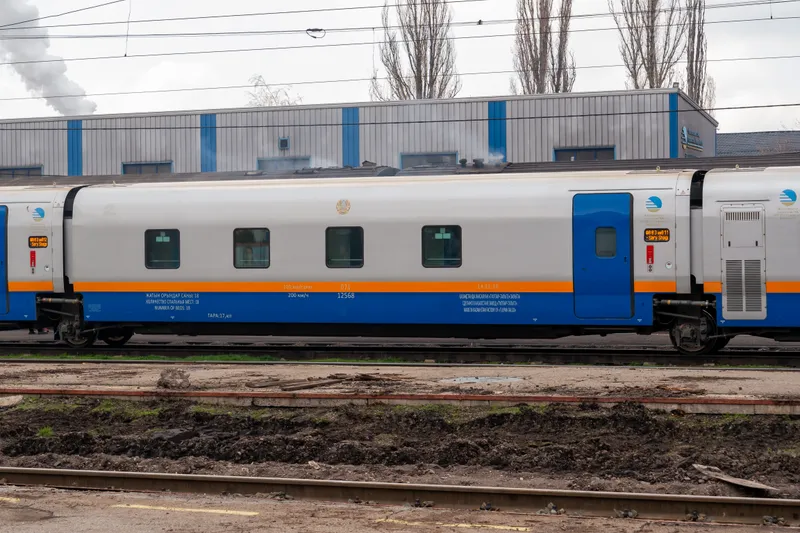
- What: The article explains how some international trains continue across breaks of gauge by using variable-gauge wheelsets or swapping entire bogies instead of making passengers change trains.
- Where: International rail border crossings in Europe and Asia where neighboring rail networks use different track gauges.
- When: Modern cross-border rail travel, with some long-established practices still in use.
Some international rail journeys hit a problem you can’t solve with speed: the tracks themselves are different widths. That means a train can reach a border and suddenly no longer fit the rails ahead.
On a few famous routes, railways address that problem without unloading everyone. They either swap out whole bogies beneath the train or run special wheelsets through gauge-changing facilities so the same trainset can keep moving.
1. Talgo variable-gauge services (Alvia/Talgo RD)
Spain’s Talgo variable-gauge trains are built for this exact moment. Their wheelsets can be unlocked and relocked in gauge-changer installations, shifting between Iberian gauge at 1,668 mm and standard gauge at 1,435 mm.
That matters because it turns a hard rail break into a brief technical stop. On routes linked to points such as Irun/Hendaye and Portbou/Cerbère, the surprise is how little drama there is: the train adapts instead of forcing passengers or cargo to transfer.
2. Brest bogie exchange on the Belarus–Poland line
At Brest, the solution is more mechanical and much more visible. Passenger coaches and some wagons are jacked up so their entire bogies can be swapped between 1,520 mm and 1,435 mm.
The striking part is how complete the operation is. Instead of changing trains, the coach body stays put while the running gear underneath is replaced. Traditionally, passengers could remain aboard during the procedure, which makes the border crossing feel both industrial and oddly seamless.
3. Zabaykalsk/Manzhouli: Russia–China bogie changes
At the Russia–China border at Zabaykalsk–Manzhouli, long-distance passenger trains face the same mismatch: 1,520 mm on one side and 1,435 mm on the other. The answer is a bogie exchange before the journey continues.
What makes this route stand out is its scale. These are not short shuttle trains but major international services. Freight often gets transloaded here, while some wagons are re-bogied, showing just how much work a break of gauge can create at a busy frontier.
4. Erenhot/Zamyn-Uud on the Trans-Mongolian
At Erenhot and Zamyn-Uud, trains on the Trans-Mongolian pause for a bogie exchange between China’s 1,435 mm gauge and Mongolia’s 1,520 mm gauge. It is a long-standing border ritual built into the trip.
For passengers, this is one of the few places where the hidden hardware of global rail travel becomes impossible to miss. The train does not simply clear customs and roll on; it has to be physically reconfigured to match the rails ahead.
5. Irun/Hendaye: Spain’s Atlantic gauge break
Irun/Hendaye is one of the best-known rail gauge breaks in western Europe. Here, Talgo gauge changers and freight facilities connect Spain’s Iberian-gauge network with France’s standard-gauge lines.
The reason this crossing matters is that it shows both the old and new answers to the same problem. Variable-gauge passenger stock enabled through-running, while bogie exchange was used historically. It is a border where engineering, not geography alone, decides whether a train keeps going.
Across these routes, the border is not just a line on a map. It is a place where trains are lifted, adjusted, or mechanically transformed so the journey can continue on rails that were never built to the same gauge.
Did You Know?
Standard gauge, used across much of Europe and China, is 1,435 mm wide and is often called the “Stephenson gauge” after railway pioneer George Stephenson.