🏺 Recovered from the dusty archives
Ada Lovelace's Notes and the First Computer Program
- What: Ada Lovelace’s 1843 notes on Babbage’s Analytical Engine described an ordered method for computing Bernoulli numbers, often cited as the first computer program, and showed a broader vision of machines following instructions to process symbols.
- Where: London
- When: 1843
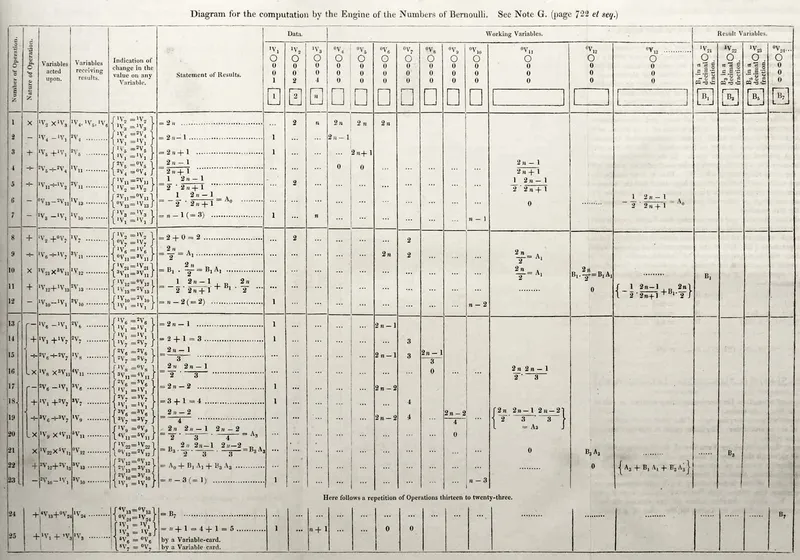
In 1843, Ada Lovelace published notes on Charles Babbage’s proposed Analytical Engine that included a step-by-step method for calculating Bernoulli numbers. That passage is often credited as the first computer program, though the label is debated because the machine itself was never completed.
The more revealing part is not just the algorithm. It is what Lovelace thought the machine was for.
Analytical Engine and Ordered Instructions
Babbage’s Analytical Engine, designed in London, was not a simple calculator in the ordinary sense. It was intended to follow a sequence of operations, using punched cards, to work through problems automatically. Lovelace understood that this mattered. In her notes, written as an expansion of an Italian paper by Luigi Menabrea, she did not just describe the engine’s parts. She described a process: what information would be entered, what operations would happen in what order, and what result would come out.
Her Bernoulli number example makes that concrete. Instead of saying the machine could “do mathematics,” she laid out a procedure the machine could execute if it existed. That is why the notes draw so much attention. They move from hardware to method, from machine to instructions.
Was It the First Program?
A common misconception is that Lovelace’s importance rests only on being “the first programmer,” as if the story begins and ends with a race for priority. There is no definitive proof that this was the first program in every possible sense, and historians have long discussed how much of the underlying work came from Babbage’s earlier ideas. But reducing the episode to a single trophy misses what is on the page.
Lovelace’s Broader Vision
Lovelace also argued that the engine could handle symbols more broadly, not just numbers, as long as those symbols could be expressed through clear rules. She even suggested that, under the right conditions, the machine might compose music of some complexity. In the 1840s, before a working general-purpose computer existed, that was a striking leap. She was describing a device whose importance would come from the instructions it followed, not just the sums it produced.
That is the concrete legacy of the Bernoulli number notes. Whether or not one calls them the first computer program without qualification, they show that by 1843 someone had already written down, in practical detail, how an unrealized machine could process ordered instructions and do more than act as a faster calculator.
Did You Know?
Ada Lovelace was the daughter of poet Lord Byron.