
🎭 Fragments from the heart of civilization
Abraham Lincoln's Pocket Watch Held a Hidden 1861 Message
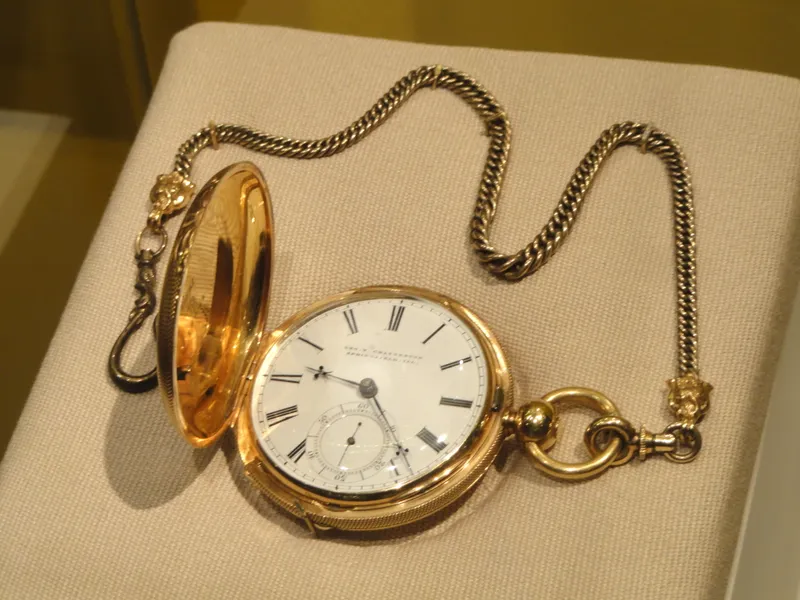
- What: Conservators at the Smithsonian opened Abraham Lincoln’s pocket watch in 2009 and confirmed that watchmaker Jonathan Dillon had engraved a hidden Civil War-era message inside it in 1861.
- Where: Washington, D.C., at the Smithsonian.
- When: April 1861, with the watch opened and the inscription verified in 2009.
Abraham Lincoln’s pocket watch carried a hidden Civil War message for nearly 150 years. The inscription, cut into the inside of the watch in Washington in April 1861, was finally opened and read at the Smithsonian in 2009.
Hidden Message Inside Lincoln’s Watch
The object came first: an English gold pocket watch with a Liverpool-made movement, used by Lincoln during his presidency. Nothing on the outside suggested a secret. But inside the movement, under the dial, watchmaker Jonathan Dillon had allegedly left a private note as the first shock of the Civil War reached the capital.
Dillon was repairing the watch on April 13, 1861, according to his later account, when news arrived that Confederate forces had fired on Fort Sumter. He said he took the moment to engrave a message inside the watch. One line referred to the attack and the date. Another mentioned that “Jonathan Dillon” engraved the piece. He also noted that the “first gun” was fired and added a patriotic remark about slavery, language that reflected his own reaction rather than any official statement from Lincoln.
Smithsonian Opens the Watch
For decades, the story sat in a half-known space between family memory and historical rumor. Dillon told The New York Times in 1906 that he had carved the inscription, but the watch itself remained closed. There was no definitive proof until conservators and curators at the Smithsonian carefully opened it in 2009, with Lincoln scholars and Dillon’s descendants present.
They found that the story was substantially true, with one important wrinkle. There was not just one inscription. Dillon had indeed engraved text inside the watch, though some details differed from how the story had been remembered over time. Other markings by later watchmakers were also present, a reminder that objects accumulate history in layers, not in a single frozen moment.
Jonathan Dillon’s Civil War Inscription
The real interest here is not that Lincoln secretly carried a coded message of state. There is no evidence he ever knew the inscription was there. What makes it compelling is smaller and more specific: an ordinary craftsman, working on a routine repair in Washington at the start of the Civil War, used the hidden interior of a watch to register his own response to a national crisis.
When the Smithsonian opened the watch in 2009, the discovery did not change the course of Lincoln history. It did something more concrete. It preserved a few scratched lines inside a presidential timepiece and linked one workbench in 1861 to one museum table nearly a century and a half later.
Did You Know?
Jonathan Dillon later told The New York Times about the inscription in 1906, decades before the watch was actually opened.