
🎭 Fragments from the heart of civilization
Palmwood Shipwreck Silk Dress at Kaap Skil
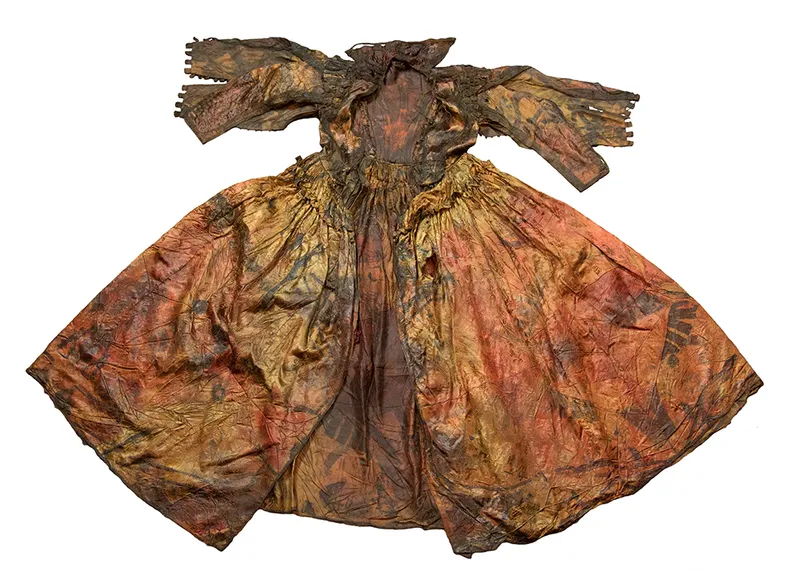
- What: A rare 17th-century silk dress recovered from the Palmwood shipwreck is on display at Museum Kaap Skil, though it is often described as a wedding dress without definitive proof.
- Where: Museum Kaap Skil on Texel in the Wadden Sea region of the Netherlands.
- When: Recovered from a 17th-century shipwreck and exhibited in the present day.
At Museum Kaap Skil on Texel, a 17th-century silk dress recovered from the Palmwood shipwreck is one of the most striking objects on display. It is often described as a wedding dress, although there is no definitive proof it was worn for a wedding. What is certain is simpler and more unusual: a fragile silk garment from the 1600s survived for centuries underwater and can be seen in a local museum.
17th-Century Silk Dress Discovery
The dress immediately explains why the find drew attention. Silk usually does not last. It tears, fades, and disappears. This one, recovered from a wreck in the Wadden Sea near Texel, held together well enough to reveal its shape, color, and elaborate patterning. The sleeves are still full. The fabric still carries a sheen. Instead of reading about early modern clothing in an inventory or seeing it flattened in a painting, visitors are looking at the thing itself.
The Palmwood shipwreck became known for preserving luxury goods in unusually good condition. Conditions on the seabed appear to have helped: low oxygen, layers of sand, and quick burial can slow decay. That does not make preservation normal. It makes this dress exceptional. Textiles from the 17th century are rare to begin with. Silk garments tied to wealth and ceremony are rarer still, because clothing was often altered, reused, or cut down long before it ever had a chance to become an artifact.
Why the Palmwood Dress Survived
That rarity is what gives the dress its weight. Paintings from the Dutch Golden Age show expensive fabrics and formal clothes, but surviving examples are limited, especially garments this complete. The Kaap Skil dress offers something paintings cannot: the scale of the skirt, the fall of the sleeves, the density of the woven decoration, and evidence of how elite clothing was actually made and worn.
There are still open questions around the wreck and the people aboard it. Researchers have debated the ship’s identity and the owner of the dress, and some details remain unconfirmed. But the basic fact does not depend on solving every mystery. On Texel, in a museum built around maritime finds, visitors can stand in front of a real silk dress from the 1600s that spent centuries under the sea. The story is not abstract. It is there in the fabric, preserved against the odds, inside Museum Kaap Skil.
Did You Know?
The Palmwood shipwreck is also known as the Palmhoutwrak.