
🌿 Stories carved by wind and water
Kiwa puravida Farms Bacteria on Its Claws
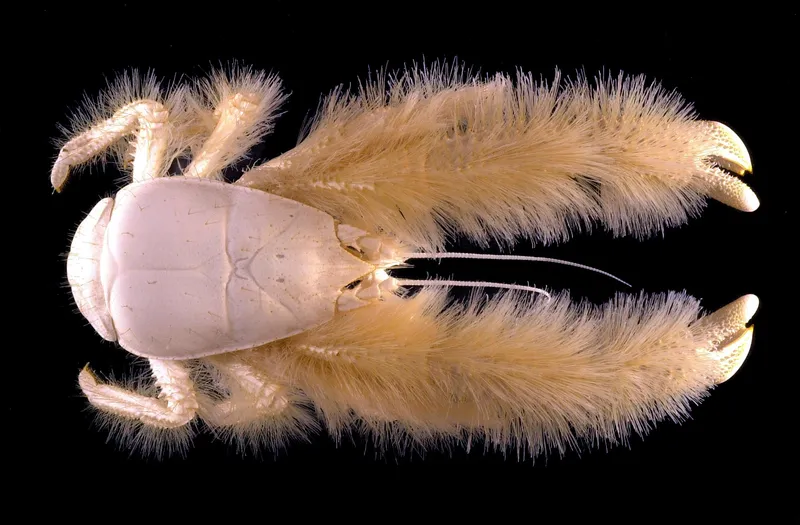
- What: Kiwa puravida is a deep-sea crab that farms sulfur-oxidizing bacteria on its hairy claws and eats the resulting biofilm.
- Where: Cold seeps off Costa Rica in the eastern Pacific Ocean.
- When: Described in 2011.
Kiwa puravida is a deep-sea crab that feeds by growing bacteria on its own hairy claws. Found off Costa Rica at cold seeps in the eastern Pacific, it lives where sulfide-rich fluids leak from the seafloor and create a chemically unusual habitat.
Bacteria on Hairy Chelipeds
The key structure is its chelipeds, the claw-bearing front limbs. They are covered in dense setae, or bristles, that act as a surface for microbial growth. On those hairs, sulfur-oxidizing bacteria form a biofilm. The crab then appears to harvest and eat that bacterial coating as food.
That feeding system depends on motion. Kiwa puravida has been observed waving its hairy chelipeds in seep fluids, exposing the bacteria to the ingredients they need. Sulfide comes from seep emissions, while oxygen is available in surrounding seawater. By moving its claws through both, the crab helps maintain conditions that support the bacterial crop.
Chemosynthesis at Cold Seeps
This matters because cold seeps are productive, but not in the usual sunlight-driven way. There is no photosynthesis at those depths. Instead, many seep ecosystems run on chemosynthesis, with microbes using chemical energy from compounds such as hydrogen sulfide. Kiwa puravida fits directly into that system: it does not just live beside chemosynthetic microbes, it carries and cultivates them on its own body.
Kiwa puravida Feeding Adaptation
The species was described in 2011, and its name references Costa Rica. Puravida is a phrase closely associated with Costa Rica, where the crab was found. It belongs to the yeti crab group, but the striking feature is not appearance for its own sake. The important detail is function: those bristles are feeding equipment.
In context, Kiwa puravida shows how specialized life can become around seafloor seeps. Rather than searching widely for food, this crab uses its chelipeds as a microbial growing surface in water rich in sulfide and oxygen gradients. Off Costa Rica, in a dark cold-seep environment, that is a hard biological fact: the crab farms sulfur-oxidizing bacteria on its hairy claws and then eats the biofilm.
Did You Know?
Kiwa puravida is one of the so-called yeti crabs, a group named for their hairy-looking claws.