
🧪 Echoes from the lab
Berezovka Mammoth Discovery Revealed a Pleistocene Last Meal
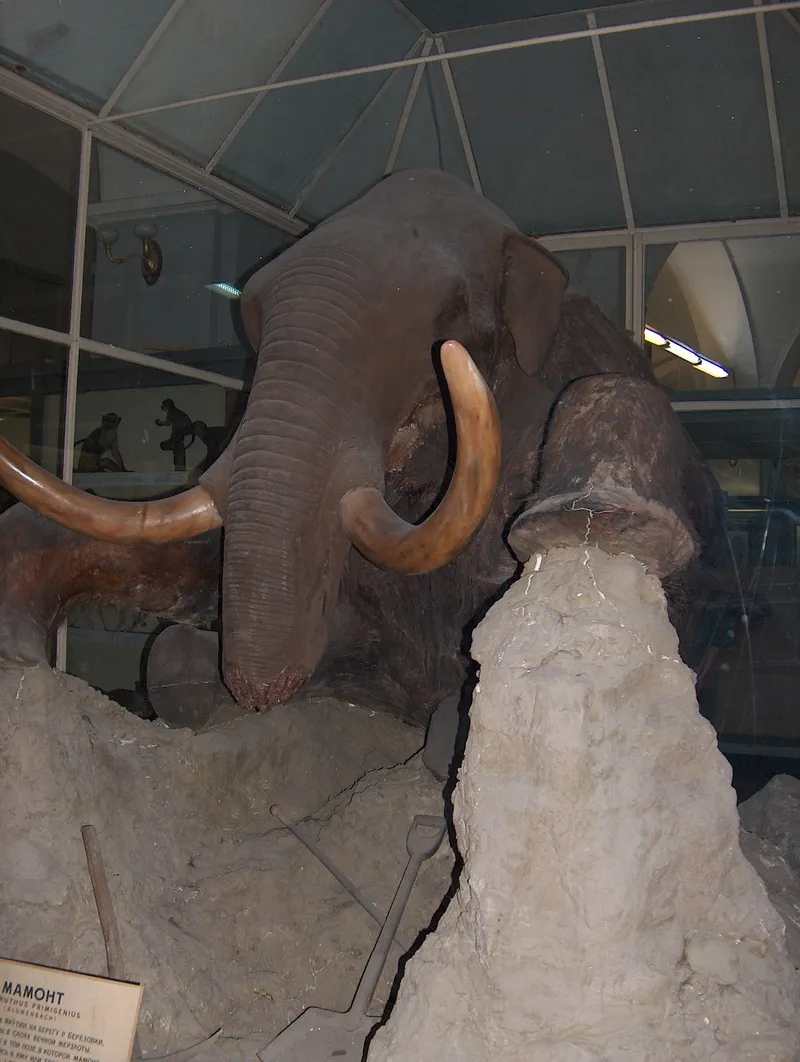
- What: A 1901 discovery of a frozen woolly mammoth in Siberia preserved stomach contents, giving scientists direct evidence of what it had recently eaten.
- Where: Siberia’s Berezovka River region, in permafrost.
- When: 1901, with the animal dating to the Pleistocene Ice Age.
In 1901, erosion along Siberia’s Berezovka River exposed the frozen body of a woolly mammoth. What made the find exceptional was not just the animal itself, but that parts of its stomach contents were still preserved.
Preserved Stomach Contents
That made the discovery unusually direct. Instead of inferring diet from teeth, tusks, or the kinds of plants known from Ice Age landscapes, researchers could examine what this mammoth had actually been eating shortly before it died. Reports from the specimen described preserved plant matter from grasses and other steppe vegetation, consistent with a grazing herbivore living in cold, open country during the Pleistocene.
The setting mattered. Siberian permafrost can slow decay so dramatically that soft tissues, hair, and internal contents sometimes survive for thousands of years. In the Berezovka mammoth, that preservation captured a narrow slice of ordinary life: not a dramatic behavior, not a symbolic moment, just food partway through digestion. That is exactly why scientists valued it. Most extinct animals leave indirect clues. This one offered evidence from inside the body.
Mammoth Steppe Diet Evidence
The find also helped ground broader ideas about the “mammoth steppe,” the cold and dry grass-dominated ecosystem that stretched across parts of northern Eurasia during the Ice Age. Woolly mammoths had long been recognized as large herbivores, but preserved gut contents provided a more immediate check on that picture. The material supported the view that these animals fed heavily on grasses and herbaceous plants, even in severe environments.
There are limits, of course. One stomach does not define the full diet of an entire species across thousands of years and a vast geographic range. Seasonal changes, local plant communities, and individual variation all matter. But that is also what makes the Berezovka mammoth so useful: it is a real sample from a real animal in a real place, not a reconstruction built only from comparison.
Why the Berezovka Find Matters
More than a century later, the Berezovka discovery still stands out because preserved stomach contents are rare in the fossil record. For Pleistocene science, this frozen mammoth did something simple and powerful. It showed, with unusual specificity, what one Ice Age grazer had just eaten on a Siberian landscape before its body disappeared into the cold.
Did You Know?
Woolly mammoth remains have also yielded DNA, which has helped researchers study their evolution and relationships to modern elephants.