
🏆 Legends born in the arena
Jesse Owens at the 1936 Berlin Olympics
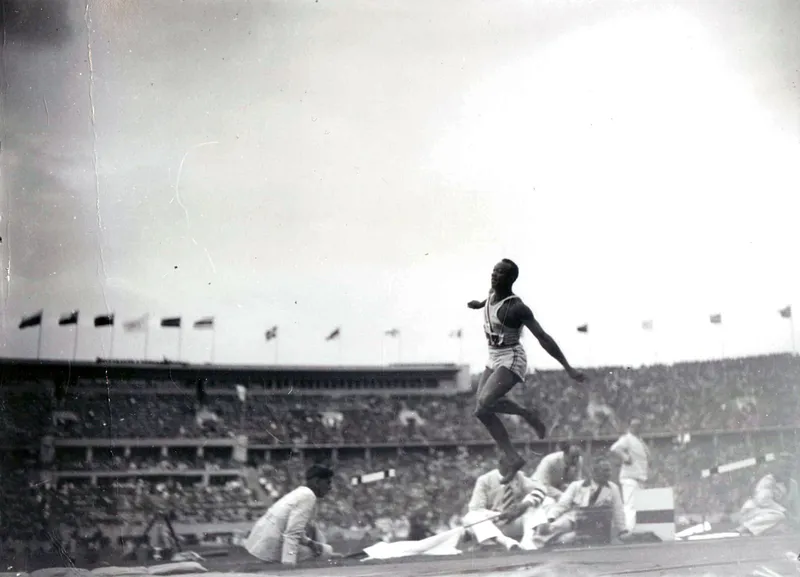
- What: Jesse Owens won four gold medals at the 1936 Berlin Olympics, publicly undermining Nazi claims of Aryan racial superiority.
- Where: Berlin, Germany, at the Olympic Stadium.
- When: August 1936, during the Berlin Olympics.
The Berlin Olympics were designed to project Nazi Germany’s image of power and racial hierarchy. Instead, in August 1936, one of the Games’ most visible stories became Jesse Owens, an African American sprinter and long jumper who won four gold medals in front of the world.
Jesse Owens’ Four Gold Medals
Owens’ impact came through the events themselves. At Berlin’s Olympic Stadium, he won the 100 meters, then the long jump, then the 200 meters, and finally the 4x100-meter relay. Each victory was public, immediate, and impossible to hide. The setting mattered as much as the medals: these were Adolf Hitler’s Games, carefully staged for international attention, and Owens kept becoming the central athlete in that spotlight.
That did not mean one man or one week shattered Nazi propaganda overnight. The regime still controlled Germany, still pushed its ideology, and still used the Olympics as a showcase. But Owens’ victories created a very visible contradiction. A Black American athlete had become the star of the Berlin Games, directly undercutting the racial claims the host government wanted the world to absorb.
Hitler Snub Story and Berlin 1936
Some details around Berlin 1936 are often simplified. The popular story that Hitler personally snubbed Owens is disputed in its usual form; historians note Hitler stopped congratulating individual winners after the first day, following Olympic guidance. Owens himself later said he did not feel personally singled out by Hitler in the way the legend suggests. The stronger, better-documented point is the broader public reality: Owens kept winning on the biggest possible stage, and that mattered more than any single handshake.
Owens and Segregated America
There is also a wider context that keeps the story from becoming myth. Owens returned home to a segregated United States, where his Olympic fame did not erase discrimination. That contrast is part of why Berlin 1936 still stands out. His victories embarrassed Nazi racial ideology abroad while also exposing the limits of equality in America at the same time.
What remains concrete is this: in Berlin, before international crowds and cameras, Jesse Owens won four Olympic gold medals in events built to measure speed, distance, and teamwork. At the very Games meant to advertise Nazi racial superiority, the most unforgettable results said something else.
Did You Know?
Owens won four gold medals at a single Olympic Games.