🧪 Echoes from the lab
Herculaneum Papyri Read by X-Ray Microtomography and AI
- What: X-ray microtomography and machine learning are helping researchers read carbonized Herculaneum scrolls without physically unrolling them.
- Where: Herculaneum, near Mount Vesuvius in Italy.
- When: The scrolls were buried in AD 79; the reading breakthrough is recent.
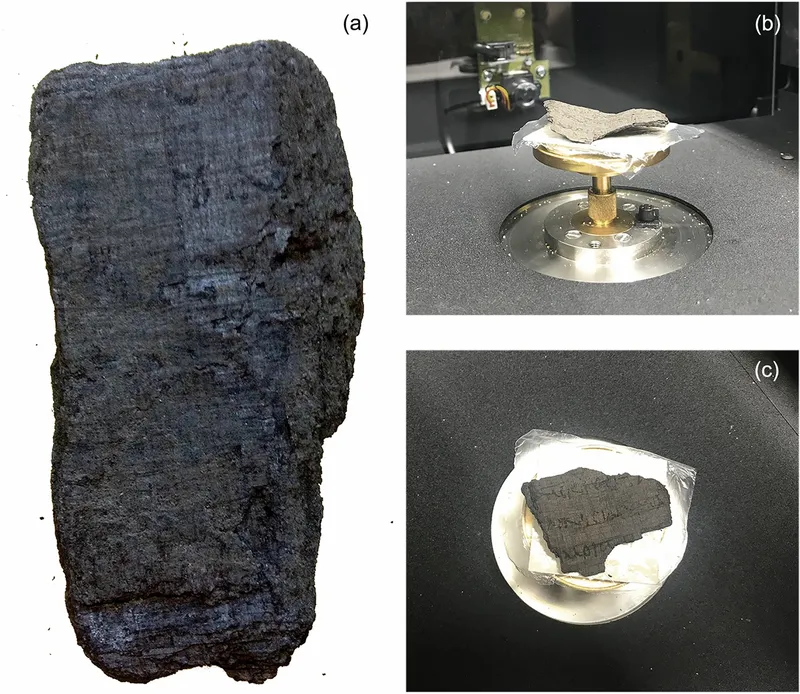
At Herculaneum, scrolls buried and carbonized by the AD 79 eruption of Mount Vesuvius have started to yield their text without being physically opened. The change comes from X-ray microtomography, paired with machine learning tools that help researchers detect hidden writing inside tightly rolled papyri.
Why the Herculaneum Scrolls Were Unreadable
For centuries, these scrolls were a frustrating kind of survival. They were preserved by disaster, then made nearly unreadable by it. Heat from the eruption turned them into fragile carbonized cylinders. Attempts to unroll some of them in earlier eras often caused damage, and many remained sealed because touching them risked destroying what was left.
The recent breakthrough did not begin with a scholar reading a visible line. It began with scans. X-ray microtomography creates highly detailed 3D images of the inside of an object, layer by layer, without cutting it open. That matters at Herculaneum because the papyrus itself and the carbon-based ink can be difficult to distinguish. Researchers have used machine learning to identify subtle patterns associated with ink traces and to help map the twisted internal surfaces of the rolled sheets.
How X-Ray Microtomography Reads Papyri
This does not mean every hidden scroll is suddenly easy to read. The process is still technically difficult. The papyri are compressed, warped, and irregular. Ink detection is not always straightforward, and interpretation still depends on careful human review. But the key shift is practical: text can be recovered from an unopened scroll, which was long treated as one of the hardest problems in manuscript research.
The Herculaneum library is especially important because it is often described as the only large library from the classical world known to have survived in situ, even in damaged form. Much of what has been identified so far appears connected to Greek philosophical writing, particularly Epicurean texts, though the collection may contain more than that. Each readable passage matters because it can preserve works already known only in fragments, or texts that have not been read in nearly two thousand years.
Why the Herculaneum Library Matters
The concrete implication is simple and significant. Instead of choosing between leaving a scroll sealed or risking damage by opening it, researchers now have a third option: scan it, model it, and recover text digitally. At Herculaneum, that turns a blackened object once treated mainly as an archaeological survivor into something closer to a readable ancient book.
Did You Know?
The Herculaneum papyri were discovered in the 18th century at the Villa of the Papyri, a Roman villa at the site.