
🏺 Recovered from the dusty archives
Vermeer Camera Obscura Theory and the Evidence in Paintings
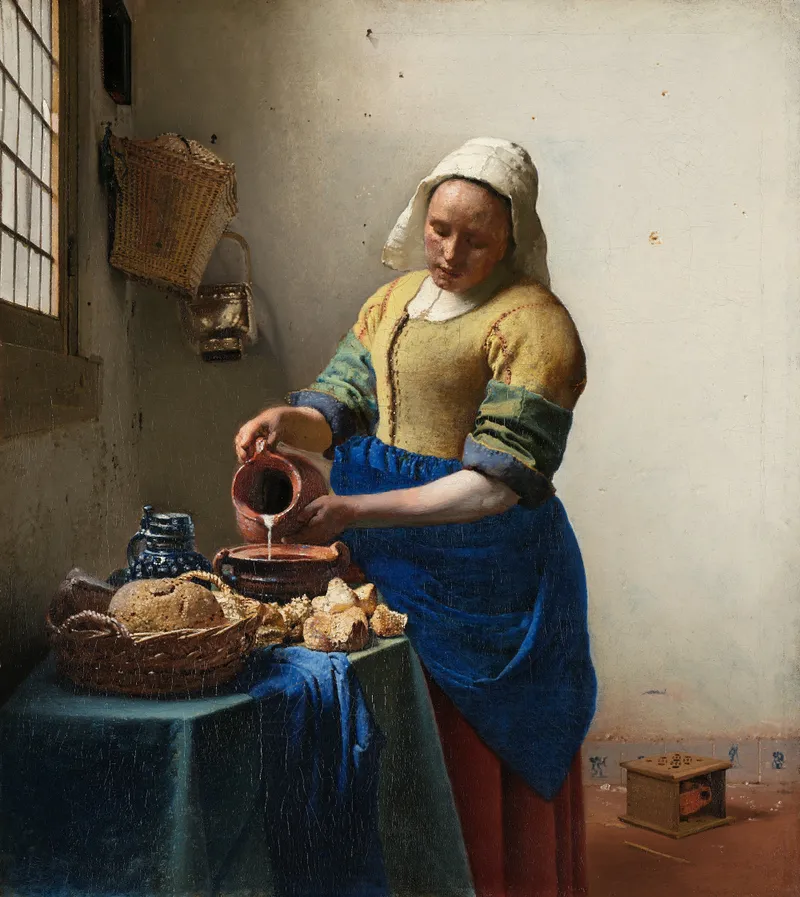
- What: The article explains that some art historians think Johannes Vermeer may have used a camera obscura, but the idea remains unproven and is based on optical effects seen in his paintings.
- Where: 17th-century Delft, the Dutch city associated with Vermeer.
- When: 17th century.
Johannes Vermeer’s paintings have long raised one question: did the Dutch artist use a camera obscura to help compose his scenes? Art historians have argued that he may have, pointing to visual details in 17th-century Delft works that resemble optical effects produced by early image projection. But there is no definitive proof, and the theory remains a careful interpretation, not a settled fact.
How a Camera Obscura Works
The basic idea is simple. A camera obscura is a darkened space or box that projects an image from the outside world onto a surface. It does not paint for the artist. What it can do is present a scene in a way that emphasizes light, blur, and framing differently from ordinary eyesight.
Optical Effects in Vermeer Paintings
That is where Vermeer enters the discussion. In paintings such as Officer and Laughing Girl, The Milkmaid, and View of Delft, some scholars have noticed tiny highlights that seem to bloom into soft circles rather than stay razor sharp. This effect is often compared to halation, where bright points appear to glow or spread slightly. Others have noted passages where perspective feels unusually precise, along with moments where edges soften in ways that resemble a lens-based image rather than a line-by-line drawing.
These details are intriguing because they are so specific. A bright reflection on metal, a pearl, or a sunlit surface can look less like a symbol of shine and more like an observed optical event. In some interior scenes, foreground objects also appear slightly larger or more abruptly cropped than viewers might expect, another feature sometimes linked to projected images or lens distortion.
What the Theory Does Not Mean
Still, the most important point is what this theory does not mean. It does not reduce Vermeer to someone using a shortcut. That is the common misconception. Even if he did use a camera obscura, no device chose the colors, arranged the emotional quiet of the room, or translated projected light into paint with such control. The machine, if it was used at all, would have been one tool inside a much larger artistic process.
That is why the debate has lasted. The evidence lives inside the paintings themselves, in small anomalies that feel almost too visual to ignore, yet not decisive enough to close the case. The result is a more concrete way of looking at Vermeer: not as a magician whose secret has been exposed, but as a painter whose extraordinary eye may have included an interest in the optical technology of his time in Delft.
Did You Know?
The term “camera obscura” is Latin for “dark chamber.”