
⚙️ Traces from the dawn of innovation
Zenith Flash-Matic Remote Failed in Sunlight, Then Changed
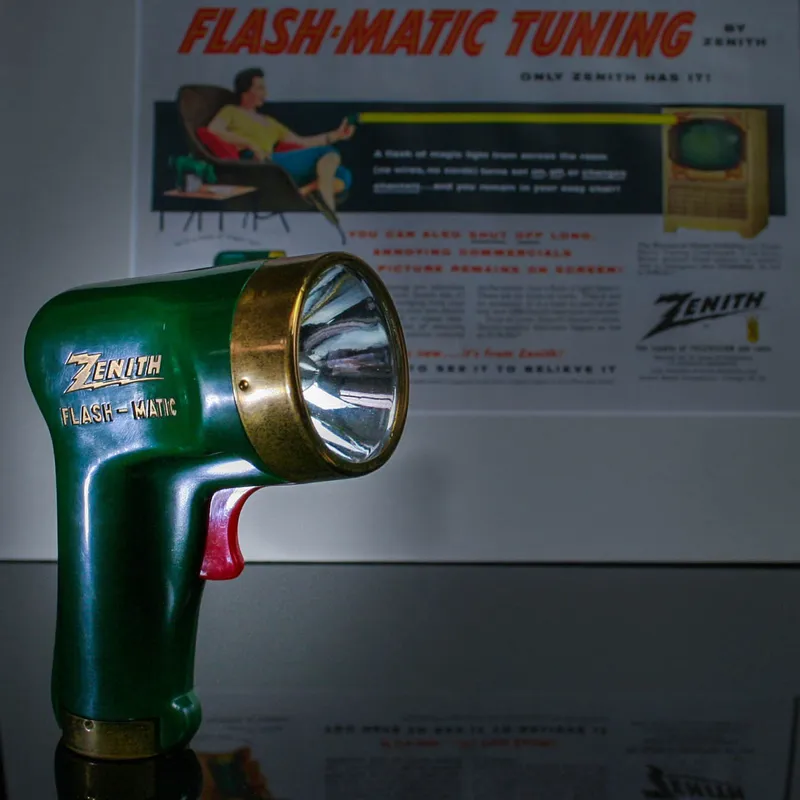
- What: Zenith’s 1955 Flash-Matic was an early wireless TV remote that used light, but sunlight and other ambient light could trigger it unintentionally, pushing Zenith toward ultrasonic remotes.
- Where: On a television set in the home.
- When: 1955–1956.
In 1955, Zenith introduced the Flash-Matic, an early wireless TV remote that looked remarkably modern for its time. But it had an almost ordinary problem: sunlight. The same light-based system that let people change channels from across the room could also react when the room got too bright.
How the Flash-Matic Worked
The Flash-Matic was developed for Zenith by engineer Eugene Polley. Instead of radio or sound, it used a directional beam of light. A viewer aimed the remote at photo cells mounted on the television set. If the beam hit the correct sensor, the TV would change channel, mute sound, or turn the picture or sound off. It was clever, simple, and fully wireless in an era when that still felt new.
The trouble came when conditions in a living room were less controlled than a demo floor. If strong ambient light, especially sunlight, struck the photo cells the wrong way, the set could respond unintentionally. A remote built around targeted light worked best when the light in the room behaved. Real homes did not always cooperate.
Sunlight and Ambient Light Problems
That flaw did not make the Flash-Matic useless, but it exposed a practical limit quickly. If a wireless remote could be triggered by ordinary daylight, then convenience became unreliable at exactly the moment it was supposed to feel effortless. Zenith’s answer came quickly. In 1956, the company moved to the Space Command remote, which used ultrasonic sound instead of light.
The shift mattered because it shows how consumer technology often changes: not when an idea is impossible, but when it collides with everyday conditions. The Flash-Matic proved that people wanted to control a television from across the room. Its sunlight issue showed that the method had to survive windows, bright afternoons, and the unpredictability of an actual home.
Zenith Space Command Shift
So the early TV remote story is not just about invention, but about correction. Zenith’s 1955 Flash-Matic established the basic promise of remote control, and its sensitivity to ambient light helped push Zenith toward ultrasonic control a year later. In concrete terms, one of television’s first remotes worked until the sun hit the set, and that was enough to send the industry in a different direction.
Did You Know?
The Flash-Matic is often credited as one of the first TV remotes to eliminate a cord entirely.