
🧩 Fragments from the unknown
Robert Falcon Scott's Tent Discovery and the Diaries
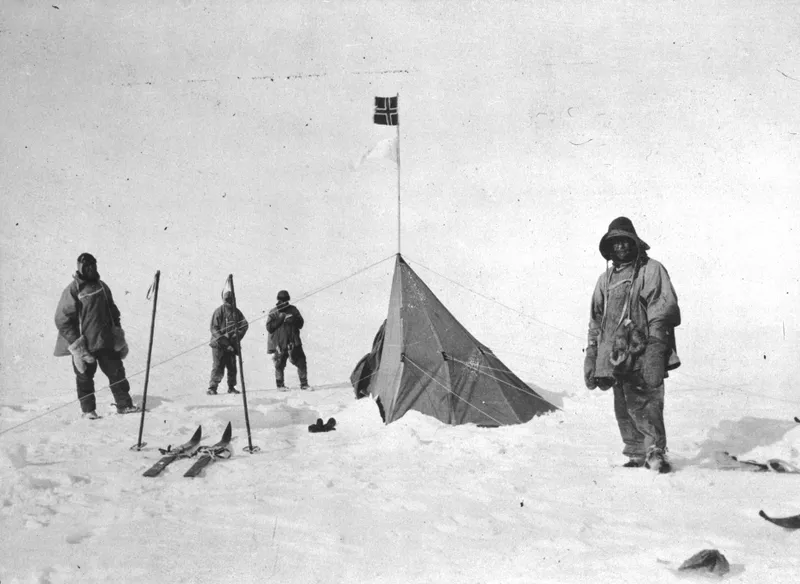
- What: Searchers found Scott, Wilson, and Bowers dead in a snow-covered tent, along with diaries and records that let historians reconstruct the final stages of Scott’s South Pole return.
- Where: Ross Ice Shelf, near One Ton Depot, Antarctica.
- When: November 1912, following the Terra Nova expedition’s 1911–1912 South Pole journey.
In November 1912, a search party moving across the Ross Ice Shelf found a tent almost hidden by snow. Inside were the bodies of Robert Falcon Scott, Edward Wilson, and Henry Bowers. What they recovered there did more than confirm the end of the Terra Nova expedition’s polar party. It gave historians a way to reconstruct, in detail, the men’s final route and last days.
Scott’s Final Return March
By the time the searchers reached the tent, Scott’s South Pole journey had already become a missing-expedition story. The party had left for the pole in 1911 and reached it in January 1912, only to find that Roald Amundsen had arrived first. On the return march, conditions worsened. Supplies ran low, weather closed in, and one by one the party broke down. Edgar Evans died first. Lawrence Oates, weakened and badly injured by frostbite, left the tent in a blizzard in March. Scott, Wilson, and Bowers continued north, but not far enough. They died in their tent, about 11 miles from One Ton Depot, a crucial supply point.
Scott’s Diaries in the Tent
The significance of the November discovery was not just the physical evidence. Scott’s diaries, letters, and records were still there. Those pages gave dates, distances, weather notes, decisions, rations, and the condition of the men. They allowed later readers to move beyond rumor and broad tragedy. Historians could trace where the polar party had traveled, when they slowed, how near they came to supply, and what obstacles they faced at each stage.
That matters because without the diaries, Scott’s final journey would have remained partly speculative. The tent fixed a location. The written record supplied sequence and context. Together, they turned disappearance into chronology. Scholars could compare Scott’s account with depot records, known routes, and later expeditions, building a far clearer picture of what happened on the return from the South Pole.
Why the Discovery Mattered
The consequence was lasting. Public memory of Scott has often shifted between admiration, criticism, and debate over leadership, planning, and weather. The diaries did not end those arguments, but they changed their basis. Instead of relying mainly on myth or secondhand retelling, historians had primary evidence from the final march itself.
That is why the snow-buried tent found in November 1912 still matters. It was not only the resting place of three men from the Terra Nova expedition. It was the site where the documents survived that made Scott’s last route, final camp, and closing weeks recoverable with unusual precision.
Did You Know?
The first human-made structure reached at the South Pole was Amundsen’s tent, left behind in 1911.